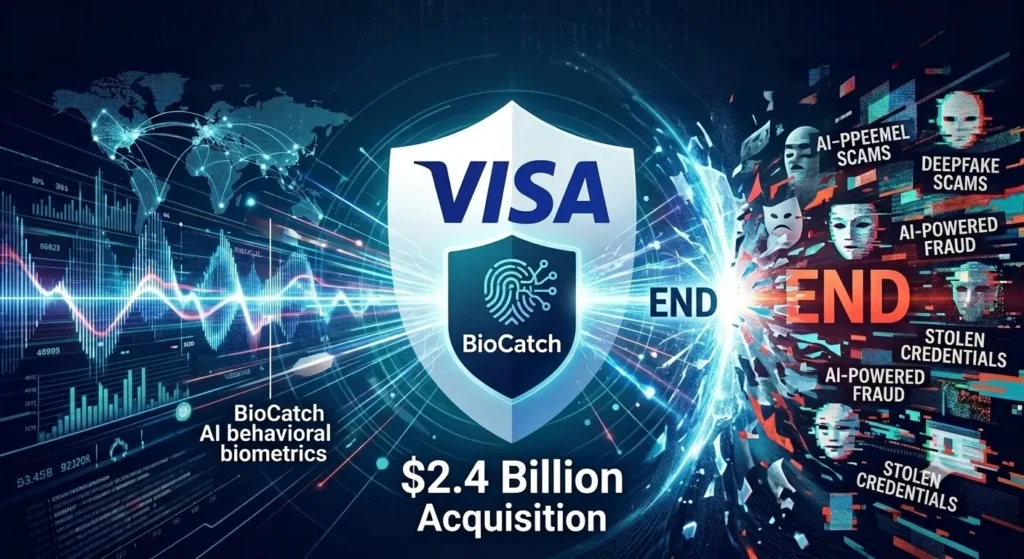
- Visa is acquiring behavioral-biometrics firm BioCatch in a $2.4 billion all-cash deal, betting fraud defense lies in how a real user behaves rather than in static credentials.
- BioCatch reads signals like typing rhythm and device handling to flag fraud in real time, protecting 1.8 billion devices and processing roughly 19 billion sessions a month.
- At nearly double BioCatch’s $1.3 billion valuation two years earlier, the price shows how strategic AI-driven fraud defense has become as scams industrialize.
- Visa — acquirer folding BioCatch into its Value-Added Services
- BioCatch — behavioral-biometrics fraud-detection firm being bought
- Permira — prior owner that valued BioCatch at $1.3 billion
In one of the largest cybersecurity deals in payments this year, Visa acquires BioCatch in a $2.4 billion all-cash transaction. It is a bet that the future of payment fraud prevention lies not in what a transaction looks like, but in how a real human behaves behind the screen. Announced on August 3, 2026, the deal signals an aggressive escalation in the fight against AI-powered fraud as generative AI makes scams faster, cheaper, and harder to detect.
For B2B leaders in banking, fintech, and e-commerce, the message is clear: behavioral biometrics has moved from a niche security layer to core infrastructure. It is part of a wider security build-out, as tech firms call for a defensive surge against AI-driven cyberattacks.
Why Visa Acquires BioCatch for $2.4 Billion
BioCatch is a fintech that pioneered behavioral biometrics, a technology that analyzes thousands of real-time signals to tell legitimate users apart from fraudsters. Rather than checking a password or a one-time code, it watches how a session unfolds.
The company’s platform monitors patterns such as:
- Keystroke dynamics and typing rhythm
- Touch gestures and swipe behavior on mobile devices
- Device handling, orientation, and navigation habits
- Coercion indicators that flag when a user is being manipulated in real time
That approach powers real-time fraud detection at massive scale. BioCatch currently protects 1.8 billion devices and 760 million users, and it serves more than 350 banking clients across 21 countries, including 100+ of the world’s largest banks. In total, the platform processes roughly 19 billion user sessions every month.
The scale behind the deal, at a glance:
| BioCatch metric | Figure |
|---|---|
| Deal value | $2.4 billion, all-cash (announced 3 Aug 2026) |
| Devices protected | 1.8 billion |
| Users protected | 760 million |
| Banking clients | 350+ across 21 countries (100+ of the world’s largest banks) |
| Sessions analyzed | ~19 billion per month |
Crucially, this is scam detection that happens before money moves. “Account takeovers and scams cost the global economy over $1 trillion annually, and AI is enabling these attacks at unprecedented scale,” said Andrew Torre, Visa’s President of Value-Added Services. “BioCatch will help our clients stop fraud before it reaches the point of payment.”
The AI Fraud Problem Behind the BioCatch Acquisition
The acquisition lands against a backdrop of surging, AI-driven financial crime. Deepfakes, voice cloning, and generative-AI phishing have industrialized account takeover (ATO) fraud and authorized push payment (APP) scams, overwhelming the rules-based systems many institutions still rely on. The AI arms race raising these risks is intensifying, as in Anthropic’s Opus 5 launch.
The stakes are enormous:
- $1 trillion+ in annual losses from account takeovers and scams globally.
- AI tooling now lets criminals scale attacks that once required manual effort.
- Static defenses such as passwords, OTPs, and device fingerprints are increasingly bypassed.
This is where behavioral biometrics offers a structural advantage. A fraudster armed with stolen credentials or a synthetic identity can pass traditional checks, but replicating the unconscious way a genuine account holder types, scrolls, and holds their phone is far harder. That behavioral signal is fast becoming one of the most reliable tools in fraud detection and broader financial crime prevention. It joins a run of blockbuster deals, alongside Uber’s $14.8B Delivery Hero acquisition.
What the BioCatch Deal Means for Visa’s Strategy
The purchase folds BioCatch into Visa’s Value-Added Services division and deepens a payment security portfolio that Visa has spent heavily to build. The company has invested more than $13 billion over five years in technology protecting the payments ecosystem. Institutions building fraud defenses increasingly evaluate verified fintech and security-solution vendors.
The strategic logic:
- Move fraud prevention upstream by catching threats before authorization, not after a chargeback.
- Strengthen bank and issuer relationships through a shared, cross-institution intelligence layer.
- Deepen recurring, high-margin services revenue beyond card processing fees.
BioCatch CEO Gadi Mazor, who stays on to lead the unit, emphasized that real-time customer-intent insights are essential for banks, and that sharing intelligence across institutions amplifies the value of behavioral data.
Notably, Permira’s controlling stake valued BioCatch at just $1.3 billion two years ago. That means Visa is paying nearly double the recent benchmark, a signal of how strategically vital AI-powered fraud defense has become.
The deal is expected to close by the end of Visa’s fiscal second quarter of 2027, subject to regulatory approval.
Frequently Asked Questions (FAQs)
Visa acquires BioCatch in a $2.4 billion all-cash transaction, announced on August 3, 2026. It is one of the largest cybersecurity deals in payments this year and is expected to close by the end of Visa’s fiscal second quarter of 2027, subject to regulatory approval.
BioCatch pioneered behavioral biometrics, analyzing thousands of real-time signals to separate legitimate users from fraudsters. It reads keystroke dynamics, touch gestures, device handling and coercion indicators to power real-time fraud detection before money moves.
AI-driven financial crime is surging: account takeovers and scams cost the global economy over $1 trillion annually. Deepfakes, voice cloning and generative-AI phishing bypass passwords and OTPs, so Visa acquires BioCatch to move fraud prevention upstream and stop scams before the point of payment.
BioCatch protects 1.8 billion devices and 760 million users, serving more than 350 banking clients across 21 countries, including 100+ of the world’s largest banks. Its platform processes roughly 19 billion user sessions every month.
Permira’s controlling stake valued BioCatch at just $1.3 billion two years ago, so Visa’s $2.4 billion price is nearly double the recent benchmark. That premium signals how strategically vital AI-powered fraud defense has become.
BioCatch folds into Visa’s Value-Added Services division, deepening a payment-security portfolio that has drawn more than $13 billion of investment over five years. BioCatch CEO Gadi Mazor stays on to lead the unit.
Not quite, but it marks a decisive shift in the arms race. Behavioral biometrics adapts in real time, moving fraud prevention from verifying identity at the door to continuously reading intent throughout a session — harder for a fraudster with stolen credentials or a synthetic identity to defeat.