- The AI build-out’s real bottleneck has shifted from GPUs to memory, with only 60–70% of global demand currently met and relief unlikely before 2028.
- Hyperscalers are diverting fabrication capacity to high-bandwidth memory, pushing projected 2026 DRAM revenue toward $372 billion and forcing consumer electronics to the back of the queue.
- Combined 2026 capex from Amazon, Google, Meta and Microsoft is forecast at $700–725 billion, and the squeeze is already rippling into passive components and GPU assemblies.
- Kearney — consulting firm that named the shift “The Great Memory Reallocation”
- Samsung, SK hynix, Micron — memory makers converting production lines to HBM
- Amazon, Google, Meta, Microsoft — hyperscalers driving the capex wave
- Nvidia — flagged component limits constraining GPU output
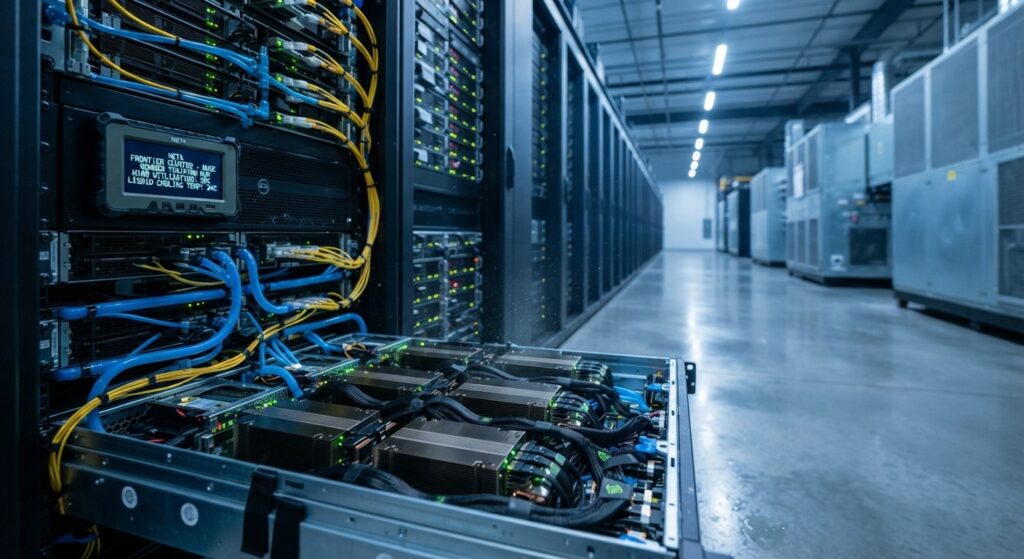
SANTA CLARA, CALIF — For the past two years, the narrative of the artificial intelligence boom has had a single protagonist: the graphics processing unit (GPU). But behind the scenes of the global data center buildout, a far more stubborn bottleneck has emerged.
The real binding constraint on the future of AI is no longer processing power; it is memory. The crunch is reshaping hardware earnings, with Lenovo’s revenue up 43% on AI demand.
The AI Data Center Bottleneck Shifts from GPUs to Memory
According to a comprehensive industry report by global consulting firm Kearney, the industry is undergoing a structural transformation dubbed “The Great Memory Reallocation”. As hyperscalers aggressively redirect fabrication capacity toward High-Bandwidth Memory (HBM) and premium, server-grade DRAM, they are leaving the rest of the tech ecosystem starved.
Currently, only 60% to 70% of unconstrained global memory demand is being met. For buyers sitting outside the top-tier hyperscaler bracket, the reality is stark: they are now at the back of an allocation queue that is unlikely to clear until 2028 at the earliest. Hyperscaler spending is straining balance sheets too, as Alibaba’s heavy AI investment is squeezing profits.
Understanding the Price Hikes of the Memory Modules
The sheer scale of this supply squeeze is reflected in unprecedented revenue projections. Market intelligence firm Omdia projects that global DRAM revenue will skyrocket to $372 billion in 2026, a jaw-dropping 147% year-on-year surge. Simultaneously, NAND flash revenue is expected to touch $300 billion, representing a massive 311% increase.
To put these numbers into perspective, separate forecasting data from Gartner, cited in recent regulatory filings, shows the enterprise share of the memory market rapidly cannibalizing traditional consumer sectors:
| Memory Segment | Revenue (2025) | Projected Revenue (2027) |
| Global DRAM | $143 Billion | $401 Billion |
| High-Bandwidth Memory (HBM) | $33 Billion | $86 Billion |
| NAND Flash | $68 Billion | $341 Billion |
| Enterprise Market Share | 43.1% | 51.9% |
This explosive growth is fueled by a breathtaking capital expenditure wave. Omdia puts the combined 2026 capex guidance from Amazon, Google, Meta, and Microsoft at a staggering $700 billion to $725 billion, up roughly 80% from 2025 levels.
How does the shortage reach the Average Consumer?
Yet, this flood of capital is not going toward creating new silicon wafers for everyday electronics. Instead, it is being funneled into converting existing production lines into advanced packaging facilities for HBM.
Major fabrication expansions, such as Samsung’s P4 facility, SK hynix’s M15X fab, and Micron’s PSMC Tongluo P5 site, are largely pre-committed to HBM and are unlikely to yield meaningful mainstream output before 2028. Rising adoption feeds the demand, even as only 16% of Japanese firms use AI company-wide.
With supply constrained, memory is cleared strictly by “willingness to pay”. High-margin AI servers easily absorb these premium pricing structures.
Meanwhile, low-margin sectors like consumer appliances and entry-level smartphones are being forced into lower-memory configurations, delayed product refresh cycles, and SKU rationalization just to remain financially viable.
Unseen Anchors of High-Speed Computing
According to Fernandes, the timeline of this shortage hinges on two wild cards:
Chinese Fabrication Capacity
How much domestic Chinese capacity (led by rapidly growing players like CXMT) can be accessed by global buyers amidst evolving geopolitical trade restrictions?
Frequently Asked Questions (FAQs)
The AI data center buildout is the root cause. Hyperscalers are aggressively redirecting fabrication capacity toward High-Bandwidth Memory (HBM) and premium, server-grade DRAM, a shift the consulting firm Kearney dubbed “The Great Memory Reallocation,” which leaves the rest of the tech ecosystem starved of supply.
Only 60% to 70% of unconstrained global memory demand is being met. Buyers outside the top-tier hyperscaler bracket now sit at the back of an allocation queue that is unlikely to clear until 2028 at the earliest.
Supply is cleared strictly by “willingness to pay,” and high-margin AI servers easily absorb premium prices. Omdia projects 2026 global DRAM revenue will reach $372 billion, a 147% year-on-year surge, while NAND flash revenue touches $300 billion, a 311% increase.
Omdia puts the combined 2026 capital-expenditure guidance from Amazon, Google, Meta and Microsoft at $700 billion to $725 billion, up roughly 80% from 2025 levels. Much of that capital funds converting existing production lines into advanced packaging facilities for HBM rather than new mainstream wafers.
Relief is unlikely before 2028. Major fabrication expansions such as Samsung’s P4 facility, SK hynix’s M15X fab and Micron’s PSMC Tongluo P5 site are largely pre-committed to HBM and unlikely to yield meaningful mainstream output before then. The timeline also hinges on Chinese fabrication capacity and whether future LLMs need less memory.
Low-margin sectors such as consumer appliances and entry-level smartphones are being forced into lower-memory configurations, delayed product refresh cycles and SKU rationalization to stay financially viable, as premium memory is diverted to AI servers that can absorb the higher prices.
Yes. The squeeze is rippling down the electronic component supply chain, with industrial distributors recording a more than 50% demand spike in programmable logic and stretched lead times for passive components like ceramic capacitors, inductors and resistors. Nvidia has warned that limited component allocations were constraining its GPU assemblies.