- OpenAI has started showing ads inside ChatGPT in India, its No. 2 market, on the Free and Go plans while keeping paid tiers ad-free.
- Agency giants WPP and Omnicom are its first partners, and a self-serve Ads Manager launched with daily budgets from ₹725.
- OpenAI says ads won't affect answers and advertisers can't access user chats, as it tests conversational AI as a third pillar of digital advertising.
- OpenAI — launching ChatGPT advertising
- WPP, Omnicom — first agency advertising partners
- Google, Meta — incumbent ad giants being challenged
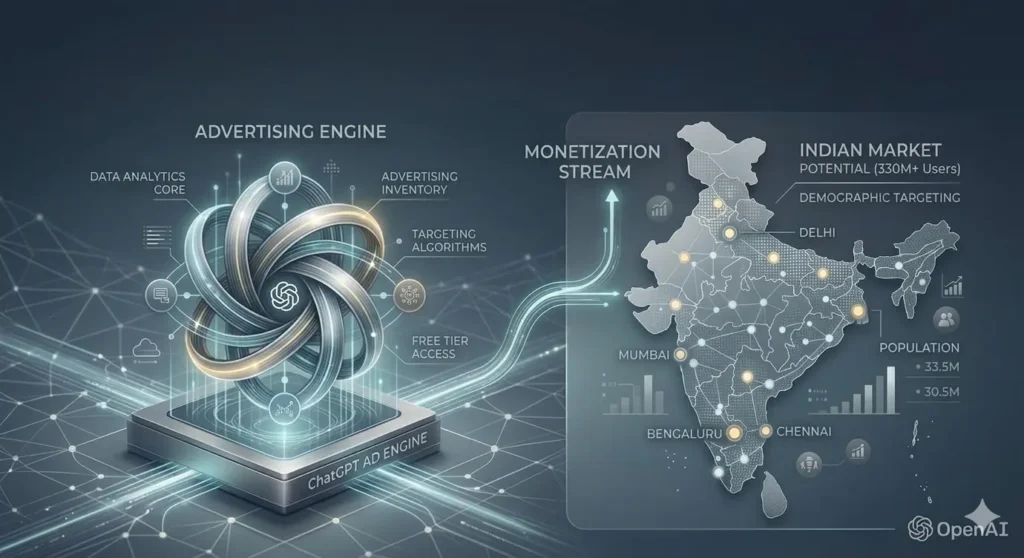
OpenAI has begun rolling out ChatGPT ads in India, its second-largest market, marking a significant step in the company's move toward advertising-based revenue. The rollout, which began August 27, 2026, places sponsored content in front of logged-in adult users on ChatGPT's Free and Go plans, while opening a new channel for businesses to reach one of the world's fastest-growing AI user bases.
Why India Is the Launchpad for ChatGPT Ads
The scale of the India opportunity explains the timing. OpenAI counts India as its second-largest market, with more than 100 million weekly active users as of February 2026, a figure that has doubled year-over-year, against a global ChatGPT base that crossed 1 billion weekly users earlier in August. In other words, India represents both enormous reach and rapid growth, making it a logical proving ground for ChatGPT ads beyond the company's initial US pilot. Monetising AI is the next battleground, as Apple hints at an AI paywall for Siri.
How ChatGPT Ads in India Work
The mechanics are designed to preserve user trust while opening the door to advertisers. Ads appear only for logged-in users aged 18 and over on the Free and Go tiers, the latter priced at ₹399 per month, while paid subscribers on Plus, Pro, Business, Enterprise, and Education plans remain ad-free. These sponsored placements are a form of conversational, AI-native advertising: sponsored products appear below ChatGPT's responses, clearly labeled and visually separated, and only when relevant. Crucially, OpenAI stated that "ads will not affect how ChatGPT generates answers," which will continue to be based on what the system considers most useful. Additionally, ads are withheld from sensitive topics including health, mental health, and politics. Enterprise AI adoption still varies globally, a reminder that only 16% of Japanese firms use AI company-wide.
The table below summarises which ChatGPT tiers show ads in the India rollout:
| Plan | Monthly price | Ad experience |
|---|---|---|
| Free | ₹0 | Ads shown to logged-in users 18+ |
| Go | ₹399 | Ads shown to logged-in users 18+ |
| Plus / Pro / Business / Enterprise / Education | Paid tiers | Ad-free |
What the Rollout Means for the Corporate Advertising Market
For the corporate and B2B advertising market, the more consequential detail is how businesses can buy in. OpenAI has partnered with agency giants WPP and Omnicom as its first advertising partners, chosen for their expertise in strategy, creative, measurement, and brand safety, with more than 50 brands expected to launch campaigns in the opening week. More significantly for smaller advertisers, a self-serve ChatGPT Ads Manager launched September 4, 2026, letting businesses run campaigns directly with daily budgets starting at just ₹725, a low entry point clearly aimed at broadening the advertiser base beyond large brands. Businesses expanding globally often pair ad spend with new supplier pipelines, and can post your sourcing requirements as an RFQ.
Privacy Safeguards for Users and Advertisers
Privacy safeguards are central to OpenAI's pitch to both users and advertisers. The company emphasized that advertisers cannot access user chats, history, memories, or personal details, and that it does not sell user data, advertisers receive only aggregate performance metrics such as impressions and clicks. Ultimately, this structure attempts to thread a difficult needle: monetizing a conversational platform without undermining the trust that makes it useful. Revenue matters as AI costs bite, seen in Alibaba’s profit squeeze from heavy AI investment.
ChatGPT Ads vs Google and Meta: A New Advertising Format
The move also positions ChatGPT as a direct challenger to established digital-advertising players. Sponsored placements inside AI conversations represent a new format, often called conversational or AI-native advertising that sits alongside, and potentially competes with, search and social ad giants like Google and Meta. For advertisers, the appeal is reaching users at the moment they are actively asking questions and seeking recommendations, a context arguably closer to purchase intent than passive feed browsing. In other words, OpenAI is not just adding a revenue line; it is testing whether conversational AI can become a genuine third pillar of digital advertising. It is the flip side of the same monetization race seen in Bilibili’s global creator-payout model.
OpenAI’s Revenue Strategy Behind the Ad Push
The strategic backdrop is OpenAI's push to diversify revenue as it scales. The company's ad model was first piloted in the US in February 2026 and reached $100 million in annualized revenue within six weeks, a pace that helped justify wider rollout. OpenAI reported Q2 2026 revenue of $6.7 billion, up from $5.7 billion the prior quarter, and confidentially filed for an IPO in June 2026. In addition, advertising gives OpenAI a monetization path that does not depend solely on subscriptions, important as competition from rivals intensifies. B2BInside recently covered Anthropic's launch of its Opus 5 model at aggressive pricing, underscoring how quickly the competitive and commercial dynamics among leading AI firms are evolving, and why OpenAI is racing to build durable revenue streams.
Whether ChatGPT ads in India succeed will depend on advertiser demand and user tolerance for sponsored content in a conversational setting. But with a self-serve Ads Manager, established agency partners, and a market of over 100 million weekly users, OpenAI has assembled the pieces to turn its second-largest market into a meaningful advertising business. Cheaper models are reshaping the economics, with Anthropic’s Opus 5 at half the price.
Frequently Asked Questions (FAQs)
OpenAI began rolling out ChatGPT ads in India on August 27, 2026, and launched its self-serve ChatGPT Ads Manager on September 4, 2026. India is OpenAI’s second-largest market and the first major expansion of ChatGPT ads beyond the initial US pilot that started in February 2026.
Ads are shown only to logged-in users aged 18 and over on the Free and Go plans, with Go priced at ₹399 per month. Paid subscribers on the Plus, Pro, Business, Enterprise, and Education tiers remain completely ad-free.
No. OpenAI has stated that “ads will not affect how ChatGPT generates answers,” which continue to be based on what the system considers most useful. Sponsored products appear below responses, clearly labeled and separated, and ads are withheld entirely from sensitive topics such as health, mental health, and politics.
No. OpenAI says advertisers cannot access user chats, history, memories, or personal details, and the company does not sell user data. Advertisers receive only aggregate performance metrics such as impressions and clicks.
Through the self-serve ChatGPT Ads Manager, businesses can run campaigns with daily budgets starting at just ₹725. Larger advertisers can work through OpenAI’s first agency partners, WPP and Omnicom, with more than 50 brands expected to launch campaigns in the opening week.
Advertising diversifies OpenAI’s revenue beyond subscriptions as it scales. Its US ad pilot reached $100 million in annualized revenue within six weeks, and the company reported Q2 2026 revenue of $6.7 billion (up from $5.7 billion) before confidentially filing for an IPO in June 2026.
ChatGPT ads are an AI-native format placed inside conversations, reaching users at the moment they are actively asking questions and seeking recommendations, arguably closer to purchase intent than passive feed browsing. OpenAI is testing whether this conversational advertising can become a third pillar of digital advertising alongside search and social giants like Google and Meta.