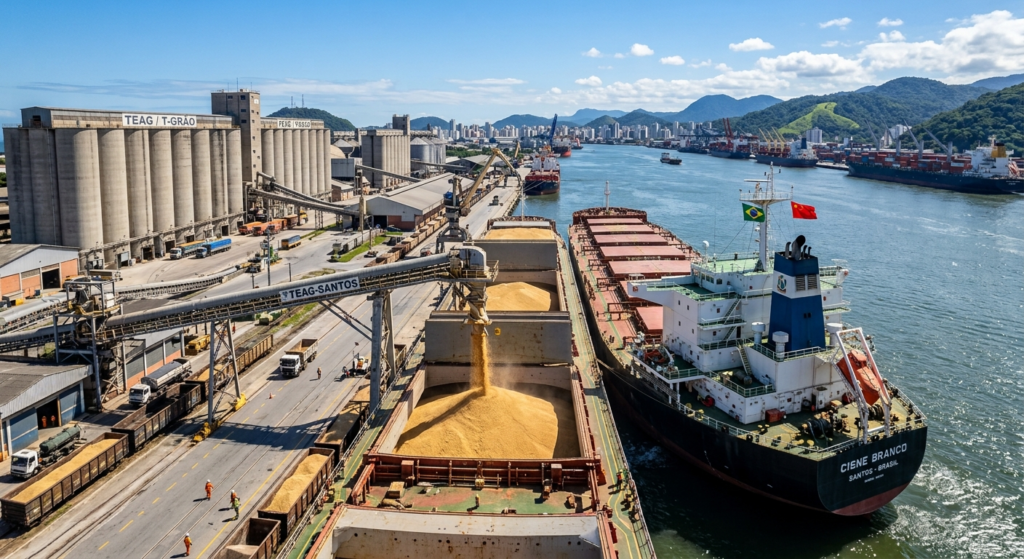
Brazil has tightened its grip on China’s soybean market. Record shipments have flowed out of the country throughout 2026, while US soybeans continue to face tariff barriers. In short, when it comes to Brazil’s soybean exports to China, Brazil is winning the battle for the world’s biggest buyer.
How big is Brazil’s lead in China’s Soybean market?
The import data shows Brazil’s growing lead clearly. Brazil supplied roughly 75% of China’s soybean imports recently, up from around 71% the year before. Brazilian shipments topped 10 million tonnes in three straight months; June, July, and August all cleared that mark. A record harvest helped fuel these strong exports.
Record Harvest Created Brazil’s Opportunity to Sell
That harvest is worth pausing on, because it explains almost everything else in this story: Brazil simply had more soybeans to sell than ever before, and it had them at a competitive price. Here is how the numbers line up.
| Figure | Value |
|---|---|
| Brazil’s 2025/26 harvest | ~178 million tonnes (a new record) |
| Brazil’s China market share (2025/26) | ~75% |
| Brazil’s China market share (year earlier) | ~71% |
| Brazilian shipments to China, June–August | Over 10 million tonnes each month |
| China’s August soybean imports | 12.14 million tonnes |
| China’s soybean imports, first 8 months | 74.11 million tonnes |
Such abundance gave Brazil ample supply to export while keeping its beans competitively priced. As a result, Chinese buyers have favored Brazilian cargoes heavily.
Where do US Soybeans fit in?
China’s overall import numbers have stayed broadly stable. August imports reached 12.14 million tonnes, down just 1.1% from a year earlier but up 5.7% from July. In other words, Chinese demand has held firm despite the trade tension.
The US-China soybean relationship, however, remains complicated:
- Chinese state traders have bought some American soybeans, roughly 11 million tonnes since May 2026.
- A bilateral commitment shapes that buying: the deal requires 25 million tonnes of US soybeans a year through 2028.
- The agreement also covers $17 billion in other US agricultural goods annually.
- A 10% retaliatory tariff on US soybeans still applies, keeping American beans less competitive than Brazilian ones.
Rosa Wang, an analyst at Shanghai JC Intelligence, captured Brazil’s dominance well: Brazil’s position has held all year, supplying close to three-quarters of China’s soybeans, up from around 71% the previous year. Brazil, in short, keeps extending its lead.
What the Brazil-China Soybean shift means for B2B Buyers?
For B2B audiences, this shift reshapes global grain flows well beyond the two countries involved. Brazil’s rise affects prices across the soybean market and even influences edible oil costs elsewhere. India, for example, feels the impact on its own import costs. Logistics and shipping patterns are adjusting accordingly, too.
This is really a story about how tariffs redirect global trade. Trade barriers push buyers toward alternative suppliers, and Brazil has captured share that once went to America. B2BInside covered a related trend recently in China Drives Massive 41% Boom in Pakistani Seafood Exports; both stories show the same pattern: Chinese demand steers entire commodity markets.
Grain traders and food producers need strong sourcing networks to keep up with shifting trade flows. Global B2B marketplaces such as Industrytc connect agricultural buyers and suppliers, helping firms source across many countries as trade patterns keep shifting.
The soybean story also carries strategic weight beyond commerce. Soybeans feed livestock and support food security, and China relies on imports to feed its herds. Brazil has become its most dependable supplier, which deepens the economic ties between the two countries.
How did Brazil build this Advantage?
Brazil’s rise did not happen overnight. The country expanded its farmland steadily for years and improved yields through better seeds and farming methods. Infrastructure investment helped move grain to ports faster, and consequently, Brazil built a genuinely reliable export machine. Long-term investment, in other words, created a lasting advantage.
China’s own buying strategy adds to this. Beijing prefers not to rely on a single supplier, so sourcing heavily from Brazil reduces its dependence on the US. That gives China more negotiating leverage and cushions it against future trade disputes with America. Brazil benefits directly from China’s caution.
Who Feels the Ripple Effects?
The shift affects farmers far beyond Brazil and China alone:
- US growers face weaker demand and lower prices.
- Argentine and other suppliers are adjusting their own strategies.
- Livestock producers everywhere watch feed costs closely.
- Food and feed businesses need more flexibility to track shifting supply sources.
For food and feed businesses, flexibility is now vital, since prices and availability can change with trade policy at any time. Strong sourcing networks are what help companies manage that uncertainty.
There’s also an industrial angle. China crushes soybeans for cooking oil and meal, and that soybean meal feeds its enormous pig and poultry herds. Steady supply keeps that entire food system running, so reliable imports carry real strategic weight; any disruption would raise food costs quickly.
What could change the Scenario?
Weather remains a key risk for both suppliers. A poor Brazilian harvest could quickly tighten global supply, since droughts or floods can sharply cut yields and push prices higher across the market.
Currency swings also affect export competitiveness, which is why buyers watch South American weather so closely.
Whether the US regains ground depends heavily on trade progress. Removing tariffs could revive American soybean sales, but Brazil’s scale and pricing remain formidable, and its record harvest only strengthens its position further. The next season will test whether that balance shifts.
Key Findings
Brazil’s record shipments mark a lasting shift, and its dominance in China now looks firmly established:
- Brazil supplies roughly 75% of China’s soybean imports, up from 71% a year earlier.
- A record 178-million-tonne harvest and competitive pricing are driving Brazil’s gains.
- US soybeans still face a 10% retaliatory tariff, despite a bilateral deal requiring 25 million tonnes of purchases a year through 2028.
- Weather in South America is now a key risk for global soybean supply.
- Reliable, flexible sourcing partners are essential for buyers navigating this shift.