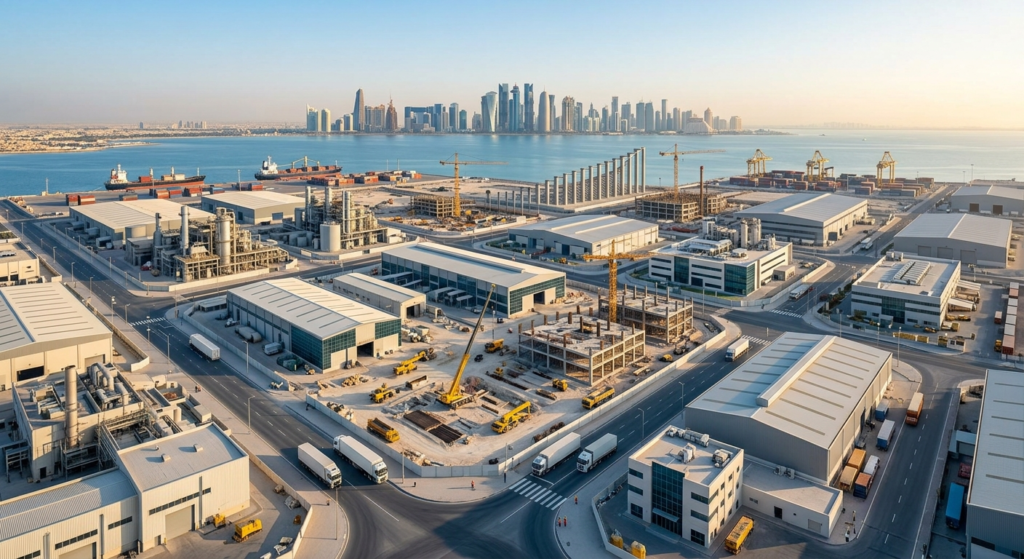
- Qatar's industrial investment reached about $68 billion by Q2 2026 as the state pushes to diversify away from hydrocarbons.
- New commercial registrations rose 6.6% quarter-on-quarter, with non-Qatari company sign-ups surging 60%.
- Eleven new factories came online and a digital “Single Window” platform is cutting registration friction, supporting the National Manufacturing Strategy 2024–2030.
- Ministry of Commerce and Industry (Qatar) — source of the registration data
- Government of Qatar — driving the diversification strategy
Qatar’s Industrial Investment Hits $68 Billion
The total value of industrial investments in Qatar reached 248.44 billion riyals (about $68 billion) by the end of the second quarter of 2026, with the Gulf state making an effort to diversify its economy away from hydrocarbons and toward a non-oil economy. At the same time, new businesses went up 6.6% in the quarter in the commercial sector, indicating that investment in the industrial sector in Qatar is starting to expand the number of businesses being established but keeping them on balance sheets.
Commercial Registrations Rise as Foreign Sign-ups Surge 60%
The trend is reflected in the registration information. The Ministry of Commerce and Industry in Qatar has issued 6,745 new commercial registrations in Q2, with a 6.6% increase compared to Q1, according to data from the ministry, cited by Arab News and Salaam Gateway. More impressively, of those, 5,272 were company registrations by non-Qataris, up 60% from Q1, suggesting foreign investors are ready to make an official move into the country. That is, Qatar’s diversification push is attracting foreign investments, not just local investment. That expansion needs global demand, met on the world’s fastest-growing B2B industrial marketplace.
New Factories and Rising Manufacturing Exports
Production was on par. During the second quarter, 11 new factories started production; as of the end of this quarter, there were 28 factories online since the beginning of 2026. The percentage of factories exporting increased to 25% of all factories in the second quarter compared with 23% in the first quarter; meanwhile, private sector exports grew by 12.5% to 900 million riyals. Such diversification into export-based manufacturing is just what policymakers have been hoping to achieve, especially for a nation whose economy has long been dependent on LNG. Export-led manufacturing is powering trade gains across the region, mirrored in China’s 41% boom in Pakistani seafood exports.
Qatar’s second-quarter 2026 industrial indicators at a glance:
| Q2 2026 indicator | Value |
|---|---|
| Total industrial investment | 248.44bn riyals (~$68bn) |
| New commercial registrations | 6,745 (+6.6% QoQ) |
| Non-Qatari company registrations | 5,272 (+60% QoQ) |
| New factories in Q2 | 11 (28 online since Jan 2026) |
| Exporting factories | 25% (up from 23%) |
| Private-sector exports | 900m riyals (+12.5%) |
| Single Window transactions | 131,269 (+4%) |
The National Manufacturing Strategy 2024–2030 Targets
Commerce and Industry Minister Sheikh Faisal bin Thani bin Thani Al Thani has presented the figures as proof that Qatar has a long-term strategy in place that is working. The current trajectory looks promising to reach the national target of 2.75 billion riyals of annual industrial investment and 70.5 billion riyals worth of added value in manufacturing by 2030, as outlined in the National Manufacturing Strategy 2024–2030. The goal of the strategy is to make the economy more resilient to energy-price fluctuations through the construction of long-term industrial capacity.
Digital Single Window Cuts Registration Friction
Digital infrastructure is quietly reinforcing the trend. The ministry’s Single Window platform processed 131,269 transactions in Q2, a 4% increase, with an 86% electronic completion rate and customer-satisfaction scores of 93% for e-submissions and 96% for government service centers. In addition, 15 new digital services were introduced during the quarter, a 25% increase. For B2B decision-makers weighing market entry, these are meaningful signals: the friction of registering and operating a business in Qatar is falling, not rising.
Intellectual-Property Activity Builds the Scaffolding
Intellectual-property activity rounded out the picture, with 1,454 trademarks registered, 130 patents granted, and 81 copyrights registered, the last up 88.4% year-over-year. Taken together, the data points to an economy building not just factories but the legal and administrative scaffolding that sustained industrial growth requires. It echoes investment magnets elsewhere, like Google’s first Pakistan office targeting a $30B giant.
Why Foreign Investors Are Moving Into Qatar
Perhaps the most significant indicator of the response is the size of the foreign-investor response (foreign direct investment, FDI). This 60% surge in non-Qatari company registrations is no coincidence; it’s likely due to the combination of regulation that has become more specific, competitive incentives, and confidence that the overall economy is stable enough to warrant a long-term investment. Just a quarter of Qatar’s 6,745 commercial registrations, of which 75.8 percent were from abroad, is a significant boost, compared with the country’s 28,000 annual figures.
What Qatar’s Industrial Investment Means for Global B2B
For international manufacturers, exporters, and trading firms evaluating the Gulf, Qatar’s numbers make a clear case. The combination of a rising industrial base, streamlined digital registration, and a 60% surge in foreign company formation suggests a market actively courting cross-border business. Companies looking to connect with verified manufacturers and suppliers across emerging industrial hubs like Qatar increasingly rely on global B2B marketplaces such as Industrytc.com to source partners and reach new buyers; a practical channel as Qatar’s export-oriented factories seek international demand. Trade-policy shifts can quickly redraw these flows, as seen in new tariffs after the US-Canada trade talks.
B2BInside has covered the growing importance of supply-chain and procurement standards in this shift, including how ESG clauses are becoming standard in Fortune 1000 supplier contracts, a reminder that as Qatar’s manufacturers court multinational buyers, compliance expectations will travel with the contracts. Ultimately, whether Qatar hits its 2030 targets will depend on sustaining this quarter’s momentum, but the second-quarter data leaves little doubt that the diversification push has moved from ambition to measurable output.
From Statistical Turnaround to Future-Proof Hub
The second quarter is more than just a statistical turnaround; it’s a testament that Qatar’s economic transformation is moving closer to fruition. This combination of forward-thinking government measures, booming foreign investment, and a changing industry is opening up a distinctive opportunity to global traders and manufacturers. But as the data shows, it’s not simply a matter of locating a local partner; it’s about being in tune with a new age of transparent operations and ESG-influenced procurement.
The future of international companies lies not just in adapting to this complex landscape but also in setting themselves up for a business world where worldwide compliance requirements are a must. If the trend is going to continue as it has, Qatar is no longer just diversifying its economy, but is increasingly becoming a legitimate, viable, and future-proof hub in the global supply chain, and the world’s buyers are noticing. A bigger industrial base fuels manufacturing exports, as when China shipped 20,000 Midea AC units to France.
Frequently Asked Questions (FAQs)
Qatar’s total industrial investment reached 248.44 billion riyals — about $68 billion — by the end of the second quarter of 2026. The figure reflects the Gulf state’s push to diversify its economy away from hydrocarbons and toward a non-oil economy.
Qatar is diversifying to make its economy more resilient to energy-price fluctuations after decades of dependence on LNG. The National Manufacturing Strategy 2024–2030 aims to build long-term industrial capacity beyond hydrocarbons.
New commercial registrations rose 6.6% quarter-on-quarter, with the Ministry of Commerce and Industry issuing 6,745 in Q2 2026. Of those, 5,272 were company registrations by non-Qataris, up 60% from Q1.
The National Manufacturing Strategy 2024–2030 targets 2.75 billion riyals of annual industrial investment and 70.5 billion riyals of added value in manufacturing by 2030. The strategy is designed to cushion the economy against energy-price swings.
Eleven new factories started production in the second quarter, bringing the total to 28 factories online since the start of 2026. The share of exporting factories rose to 25% from 23%, while private-sector exports grew 12.5% to 900 million riyals.
The Single Window is the Ministry of Commerce and Industry’s digital platform for business registration and services. It processed 131,269 transactions in Q2 — a 4% increase — with an 86% electronic completion rate and satisfaction scores of 93% for e-submissions and 96% for government service centres, cutting the friction of setting up in Qatar.
A rising industrial base, streamlined digital registration and a 60% surge in foreign company formation signal a market actively courting cross-border business. International manufacturers and exporters increasingly source verified partners through global B2B marketplaces such as Industrytc.com, while ESG and compliance expectations travel with the contracts.