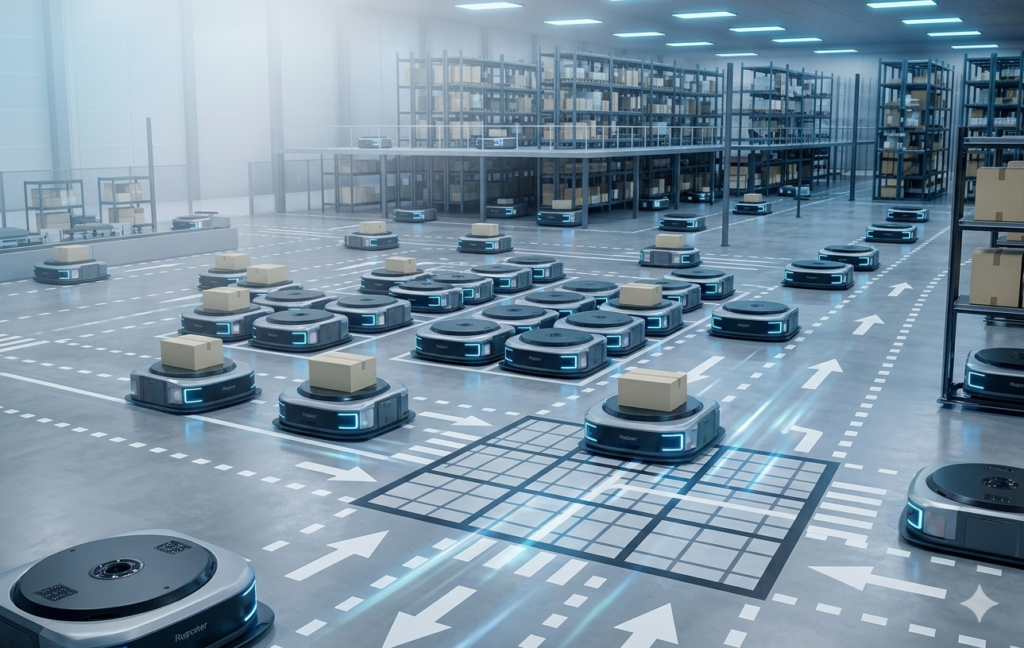
LONDON — A quiet revolution is unfolding inside Britain’s warehouses, and it is being written in Mandarin. Chinese robotics leader Geek+ now has more than 2,000 autonomous mobile robots operating across ten UK warehouse sites, powering the fulfilment operations behind household retail names including Tesco, Asda, and Next. Britain has become Geek+’s single largest market in Europe, a striking position for a country long criticised for lagging on industrial automation.
It’s not by chance. Persistent labour shortages, poor productivity over the last decade and the increasing pressure to meet online orders faster and cheaper are a challenge for UK retailers. There’s a solution: automation, and the Chinese are the most readily available and economical means to get robots into the warehouse. It mirrors China’s retail push West, from stores to Shein’s Hong Kong debut.
Geek+, which listed on the Hong Kong exchange in 2025, is the world’s largest supplier of autonomous mobile robots. Its fleets glide across warehouse floors carrying shelves directly to human pickers, cutting the miles staff walk each day and dramatically speeding up order processing. In the UK, deployment is handled by partner MotionTech. Meanwhile, the Account Director Barry Pemberton summed up the appeal bluntly: customers “want fast deployable solutions… ultimately on a smaller footprint with reduced headcount.”
That value proposition is landing at exactly the right moment. According to a 2026 OECD report, the UK has surprisingly low robotics adoption for a nation with such deep manufacturing heritage, leaving significant room for rapid catch-up as retailers race to modernise.
The next wave is on the horizon. Geek+ revealed Gino 1 in February 2026 and claims it is the first humanoid robot designed for use in a warehouse environment. Gino 1 features three-finger dexterous hands, force-controlled dual arms, and a proprietary “Geek+ Brain” trained on real warehouse data to tackle the complex picking and sorting tasks that still make up over 50 percent of warehouse operating costs. The commercial opportunity is huge: more than 70% of warehouses out there still have manual labour on board, and Geek+ claims to have gotten validation from a Fortune 500 customer in just three months after launching. Automation is reshaping fulfilment everywhere, as Amazon Prime Air expands to nearly 500 US cities.
Chinese rivals are pushing hard in the same direction. EV maker XPeng is developing its “Iron” humanoid, while AgiBot and Unitree are investing billions into next-generation machines.
For B2B buyers, from sourcing teams to logistics operators, the message is clear: automation with Chinese robotics companies is a competitive equalizer in retail supply chains. However, there are some kinks to work out. The Trades Union Congress says businesses should use technology to raise productivity and enhance employment, rather than just to save money, and should engage workers in decisions on automation.
The next act will be about how Britain can achieve efficiency gains without compromising on staff protection. The direction of travel is not in doubt, and more and more the robots driving the change feature the “Made in China” label. Chinese goods keep flowing into Western markets, like the 20,000 Midea AC units shipped to France.