- Seafood shipments from Pakistan to China jumped 41% year-on-year to $220 million over the first seven months of 2026.
- Growth is broad-based across frozen fish, cuttlefish and mud crabs, concentrated in a few Chinese coastal provinces led by Fujian.
- Reduced tariffs under the China-Pakistan FTA's second phase give exporters a cost edge, with China alone nearing a third of Pakistan's full-year seafood target.
- General Administration of Customs China (GACC) — source of the trade data
- Government of Pakistan (Maritime Affairs Ministry) — set the $600 million export target
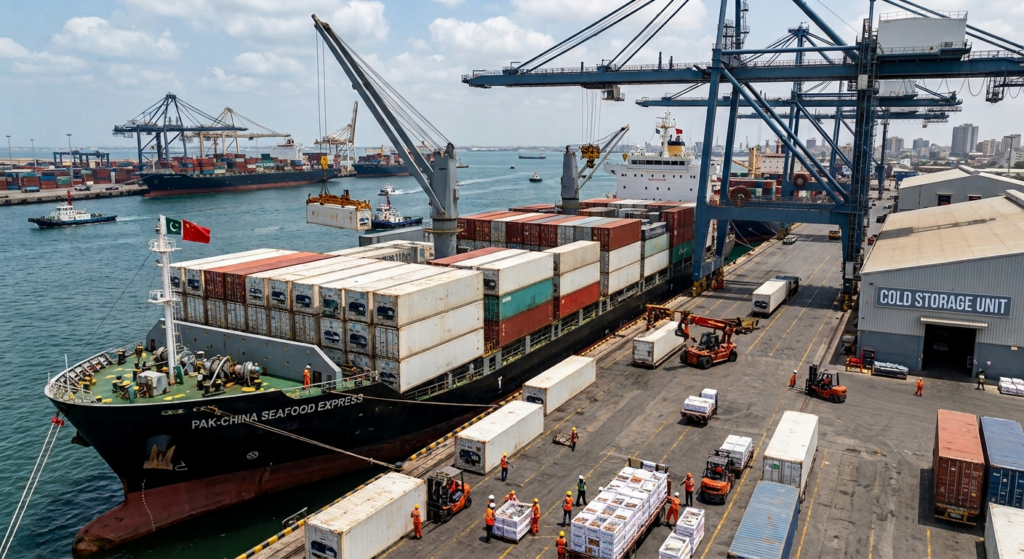
Pakistan’s seafood exports to China rose 41% year-over-year in the first seven months of 2026, reaching $220 million compared to $156 million in the same period last year, according to data from China’s General Administration of Customs (GACC). The trend in Pakistan’s seafood exports to China has been building for several years, but this jump marks one of the sharpest acceleration periods yet, positioning seafood as a fast-growing category in bilateral trade beyond Pakistan’s traditional textile and copper exports.
Broad-Based Growth Across Frozen Fish, Cuttlefish and Mud Crabs
The growth is broad-based rather than concentrated in a single product line. Frozen whole fish led the category at $40.04 million (19,834 metric tons), followed by frozen cuttlefish and squid at a combined $36.39 million, and frozen sardines and sprats at $19.49 million (22,458 metric tons). Live and chilled mud crabs contributed $18.70 million, with frozen octopus, fish fillets, and shrimp rounding out the top categories. Additionally, Pakistan ranks third globally in mud crab exports and ships more than 3,000 tons of live mud crabs to China annually, making China by far Pakistan’s largest buyer in that specific niche. The surge is part of China’s wider export machine, from seafood to how China shipped 20,000 Midea AC units to France.
The leading product categories in the seven-month total break down as follows:
| Product category | Export value | Volume |
|---|---|---|
| Frozen whole fish | $40.04 million | 19,834 metric tons |
| Frozen cuttlefish & squid | $36.39 million (combined) | — |
| Frozen sardines & sprats | $19.49 million | 22,458 metric tons |
| Live & chilled mud crabs | $18.70 million | 3,000+ tons/year of live crab |
Which Chinese Provinces Are Buying Pakistani Seafood
Chinese demand is concentrated in a handful of coastal provinces. Fujian led all destinations at $32.58 million, or 21.14% of total seafood imports from Pakistan, followed by Guangdong at $27.50 million (17.84%), Shandong at $22.88 million (14.85%), and Zhejiang at $22.04 million (14.30%). Shanghai and Yunnan rounded out the top six. In other words, five or six provinces account for the overwhelming majority of Chinese demand, giving Pakistani exporters a relatively concentrated set of markets to focus logistics and relationship-building efforts on rather than a fragmented national market.
| Chinese province | Import value | Share of total |
|---|---|---|
| Fujian | $32.58 million | 21.14% |
| Guangdong | $27.50 million | 17.84% |
| Shandong | $22.88 million | 14.85% |
| Zhejiang | $22.04 million | 14.30% |
Trade Infrastructure and Customs Registration for Exporters
The trade infrastructure behind this growth is worth noting for B2B readers evaluating market entry. Approximately 200 Pakistani seafood exporters and 10 fish-meal producers currently hold formal registration with Chinese customs, a prerequisite for legally exporting into China under its food-safety and traceability requirements. Muhammad Imran, Trade and Investment Counsellor at the Pakistan Consulate in Guangzhou, said seafood “has become one of the faster-growing non-textiles, non-copper categories in bilateral trade,” a framing that positions seafood alongside Pakistan’s broader push to diversify its China-facing export base. Trade diversification is lifting other regional economies too, such as Qatar’s industrial base rising to $68B.
How the China-Pakistan FTA Fuels the Cost Advantage
The China-Pakistan Free Trade Agreement, in its second phase, provides zero or reduced tariffs across an expanded list of seafood species, and Pakistani officials are reportedly negotiating for further preferential listings. Additionally, this tariff structure gives Pakistani exporters a cost advantage over competitors from countries without comparable trade agreements with China, a factor that likely explains part of why growth has accelerated even as other China-Pakistan trade categories have shown more mixed results this year.
A Pace That Is Compounding, Not Just Continuing
The pace of acceleration stands out against Pakistan’s own recent trajectory. The Chinese embassy in Islamabad reported that Pakistan’s seafood exports to China grew 24% to $240 million across the first 11 months of 2025. Those flows now face fresh friction after new tariffs from the US–Canada trade talks.
In other words, Pakistan’s seven-month total for 2026 has already reached roughly 92% of the entire prior year’s 11-month figure, a clear sign that growth is not just continuing but compounding. Most of the underlying product moves through coastal hubs in Gwadar, Pasni, and Karachi, spanning Balochistan and Sindh provinces, where cold-chain logistics investment has improved in recent years alongside expanded market access.
Seafood as a Strategic Export for Pakistan’s Economy
China now ranks among Pakistan’s largest seafood destinations alongside Thailand, Vietnam, and Middle Eastern buyers, and Islamabad has framed food exports broadly, seafood included, as a strategic tool for strengthening foreign exchange reserves and reducing reliance on textile exports. The same cross-border trade currents are reshaping retail, as in Shein’s Hong Kong debut.
This growth also sits within a larger national target. Pakistan’s Federal Maritime Affairs Ministry has set a $600 million seafood export target for fiscal year 2025-26, up from $465 million in FY2024-25, meaning China alone accounted for roughly a third of that full-year target within just seven months, well ahead of pace if growth holds through the remainder of the fiscal year. Reaching the broader target will likely require continued diversification beyond China, but the current trajectory suggests China-bound seafood exports are outperforming expectations rather than lagging behind them.
In the end, whether this pace of growth is sustainable will depend on factors outside Pakistan’s direct control, including Chinese consumer demand trends and any shifts in provincial import patterns. But with formal customs registration already in place for roughly 200 exporters and tariff preferences locked in under the FTA’s second phase, Pakistan’s seafood sector currently has more structural tailwinds working in its favor than most of the country’s other export categories. Exporters scaling shipments increasingly connect with verified suppliers and global buyers on B2B marketplaces.
Frequently Asked Questions (FAQs)
Pakistan’s seafood exports to China rose 41% year-over-year in the first seven months of 2026, reaching $220 million compared to $156 million in the same period a year earlier, according to China’s General Administration of Customs (GACC). It marks one of the sharpest acceleration periods yet for the category.
Growth is broad-based. Frozen whole fish led at $40.04 million, followed by frozen cuttlefish and squid at a combined $36.39 million, frozen sardines and sprats at $19.49 million, and live and chilled mud crabs at $18.70 million, with octopus, fish fillets, and shrimp also contributing. Pakistan ranks third globally in mud crab exports.
Demand is concentrated in a few coastal provinces. Fujian led at $32.58 million (21.14%), followed by Guangdong at $27.50 million (17.84%), Shandong at $22.88 million (14.85%), and Zhejiang at $22.04 million (14.30%), with Shanghai and Yunnan completing the top six.
The China-Pakistan Free Trade Agreement, now in its second phase, provides zero or reduced tariffs across an expanded list of seafood species, with officials negotiating further preferential listings. This gives Pakistani exporters a cost advantage over competitors from countries without comparable trade agreements with China.
Exporters must hold formal registration with Chinese customs, which enforces food-safety and traceability requirements. Roughly 200 Pakistani seafood exporters and 10 fish-meal producers currently hold that registration, and most product moves through coastal hubs in Gwadar, Pasni, and Karachi across Balochistan and Sindh.
In 2025, exports grew 24% to $240 million across the first 11 months, per the Chinese embassy in Islamabad. Pakistan’s seven-month total for 2026 ($220 million) has already reached about 92% of that full 11-month figure, showing growth that is compounding rather than merely continuing.
Islamabad frames food exports, including seafood, as a tool for strengthening foreign exchange reserves and reducing reliance on textiles. The Federal Maritime Affairs Ministry set a $600 million seafood export target for FY2025-26, up from $465 million in FY2024-25, and China alone accounted for roughly a third of that target within seven months.