- US-Canada trade talks collapsed at the August 22, 2026 deadline, triggering 50% US tariffs on about $20 billion of Canadian goods.
- Canada vowed to match the tariffs “dollar for dollar,” with retaliation on US steel, dairy and electronics taking effect September 8.
- Planned reductions on vehicle, steel and aluminum tariffs fell through, though economists still call the overall GDP impact contained.
- Office of the US Trade Representative — imposed the new tariffs
- Government of Canada — pledged dollar-for-dollar retaliation
- RBC Economics — estimated the contained GDP impact
Three days of negotiations in Washington, DC ended without an agreement, and the US-Canada trade deal deadline that expired at 12:01 a.m. Eastern Time on Saturday, August 22, 2026, has triggered a fresh round of tariffs rather than the deal both sides had signaled was close just days earlier.
What the New US–Canada Tariffs Cover
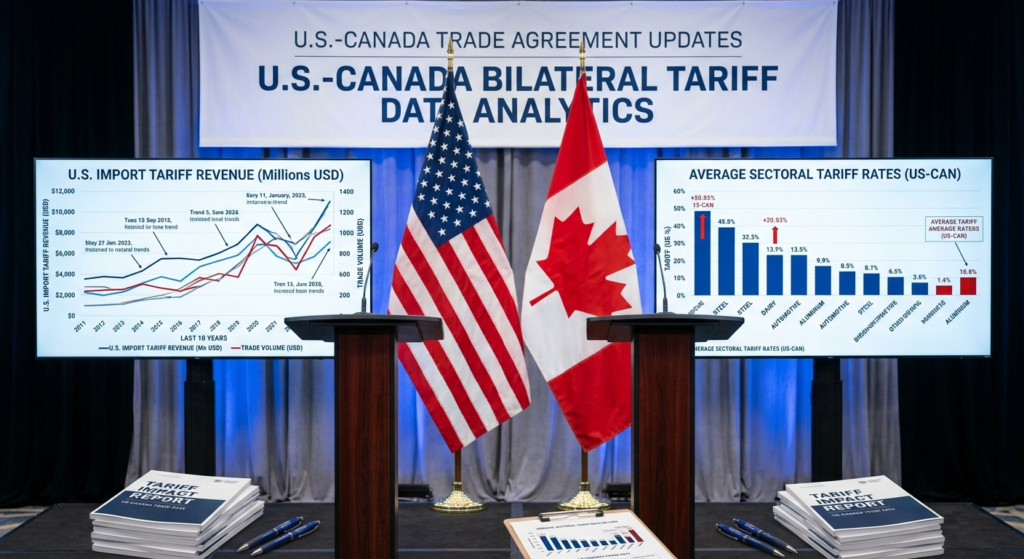
The US imposed 50% tariffs on roughly $20 billion worth of Canadian goods, about 5% of Canada’s total exports to the US, covering categories including dairy products, alcoholic beverages, cement, and hockey equipment, according to reporting independently confirmed by CNN, NPR, Al Jazeera, and the Washington Post. Tariff volatility is pushing buyers to rewrite terms — the same shift making ESG clauses standard in supplier contracts.
At a glance, the new US–Canada trade measures break down as follows:
| Measure | Detail |
|---|---|
| US tariff rate | 50% on roughly $20 billion of Canadian goods (~5% of Canada’s exports to the US) |
| US-tariffed categories | Dairy products, alcoholic beverages, cement, hockey equipment |
| Canada’s retaliation | Dollar-for-dollar counter-tariffs from September 8, 2026 on US steel, dairy, appliances, agricultural equipment, pulp and paper, electronics |
| Reductions that fell through | Vehicle tariffs 25%→15%; steel and aluminum tariffs 50%→25% (did not materialize) |
| Canada’s effective tariff rate | Expected to rise to ~6% from ~3% |
How US–Canada Trade Talks Collapsed at the Deadline
The breakdown followed a rapid shift in tone. As recently as Thursday, Canadian Trade Minister Dominic LeBlanc had described the two sides as “very close” to a deal, and President Trump said he expected an agreement was achievable. By Friday night, talks had failed. Prime Minister Mark Carney said the United States had introduced last-minute changes that were “uneconomic, unfair and undermined the net benefits for Canada,” and he suspended negotiations, directing Canadian negotiators to return to Ottawa.
Two Sides, Two Accounts of the Breakdown
The two sides offered sharply different accounts of the breakdown. US Trade Representative Jamieson Greer said Canada “declined to finalize the trade deal” and introduced new demands, adding that the US had offered “significant tariff reductions on steel, aluminum, autos, and lumber” before talks collapsed. Carney’s account places the blame on Washington instead, describing the final US proposal as one that “called into question the reliability of any deal.”
Canada’s Dollar-for-Dollar Retaliation
In response, Carney announced Canada will match the new US tariffs “dollar for dollar,” with retaliatory tariffs taking effect September 8, 2026, the Tuesday after Labour Day, targeting US steel, dairy, appliances, agricultural equipment, pulp and paper, and electronics. “Canada will match those tariffs dollar for dollar to protect our workers and businesses,” Carney said. The US-Canada trade talks collapse also means the sectoral tariff reductions under discussion, cutting vehicle tariffs from 25% to 15%, and steel and aluminum tariffs from 50% to 25%, did not materialize, leaving those higher rates in place for now.
Additionally, Canada’s provincial alcohol bans, a sticking point throughout the talks, with US liquor barred from sale in every province except Alberta and Saskatchewan, remain unresolved, removing what had been floated as a goodwill gesture toward a broader agreement.
What the US–Canada Trade Fallout Means for B2B Supply Chains
For B2B manufacturers, exporters, and supply-chain planners, the practical stakes are significant. Canada sends roughly 70% of its exports to the United States, making it acutely exposed to swings in bilateral trade policy, a dependency that cuts both ways now that steel, dairy, appliance, and electronics exporters on both sides of the border face new costs. It also reshapes export booms like China’s 41% surge in Pakistani seafood exports.
In other words, companies that had been planning around an expected reduction in steel and aluminum tariffs now need to plan around the opposite outcome, at least through early September and likely longer if talks remain suspended.
The timing also matters for procurement teams. Canada’s retaliatory tariffs do not take effect until September 8, leaving a roughly two-week window before the second wave of costs hits cross-border supply chains. Ultimately, that gap gives businesses on both sides a narrow opportunity to adjust sourcing, accelerate shipments, or renegotiate contracts before the full weight of the new tariff regime lands on both economies simultaneously. Tariff swings hit global automakers hard as well, compounding pressures like Toyota’s global sales decline.
Macroeconomic Impact: Contained but Concentrated
The macroeconomic stakes, while real, are more contained than the political rhetoric suggests. RBC Economics estimates the Canadian value-added content of the newly tariffed imports at roughly 0.4% of Canadian GDP, concluding the impact is “likely not large enough to derail Canada’s economic growth backdrop.” Over 80% of Canadian exports remain duty-free under CUSMA (the Canada–United States–Mexico Agreement), and the most exposed sectors, plastics, electrical machinery, furniture, and wood products, are concentrated in Quebec, British Columbia, and Ontario. Elsewhere, industrial expansion is accelerating, as in Qatar’s industrial base rising to $68B.
Canada’s average effective tariff rate is expected to rise to roughly 6% from about 3%, still below the near-7% rate the US applies to imports from all countries. That framing doesn’t make the disruption trivial for the specific exporters caught in the affected categories, it simply means the damage is concentrated rather than economy-wide, for now.
A Fast-Moving Trade War With an Open Question
This is not the first time global supply chains have faced sudden, hard-to-plan-for disruption this year, B2BInside recently covered China’s emergency shipment of 200,000 Midea air conditioning units to France during a heatwave, a reminder that cross-border logistics are increasingly exposed to both weather and policy shocks with little advance warning. Additionally, the speed of this collapse, from “very close” on Thursday to active tariffs by Saturday, illustrates how quickly this trade war can escalate even after months of apparent progress.
Whether the two governments return to the table before September 8 remains the open question. Both Carney and Trump have previously restarted stalled talks under similar pressure, and neither country’s exporter’s benefit from an extended standoff. For now, though, the deadline that was supposed to produce an agreement has instead produced the opposite: the first significant tariff escalation between the two countries in this round of negotiations. Firms hedging duties are diversifying sourcing by posting buying requests to alternative suppliers.
Frequently Asked Questions (FAQs)
The US–Canada trade deadline expired at 12:01 a.m. Eastern on Saturday, August 22, 2026, without a deal. Prime Minister Mark Carney said Washington introduced last-minute changes he called “uneconomic, unfair,” and he suspended negotiations, directing Canadian negotiators back to Ottawa. US Trade Representative Jamieson Greer countered that Canada “declined to finalize the trade deal” and introduced new demands.
The US imposed 50% tariffs on roughly $20 billion of Canadian goods, about 5% of Canada’s total exports to the US. The affected categories include dairy products, alcoholic beverages, cement, and hockey equipment, per reporting confirmed by CNN, NPR, Al Jazeera, and the Washington Post.
Canada is matching the US measures “dollar for dollar,” with retaliatory counter-tariffs taking effect September 8, 2026. They target US steel, dairy, appliances, agricultural equipment, pulp and paper, and electronics. Carney framed the response as protecting “our workers and businesses.”
The sectoral cuts under discussion did not materialize. Vehicle tariffs were set to drop from 25% to 15%, and steel and aluminum tariffs from 50% to 25%, but the collapse left those higher rates in place for now.
RBC Economics estimates the Canadian value-added content of the newly tariffed imports at roughly 0.4% of GDP, “likely not large enough to derail Canada’s economic growth backdrop.” Over 80% of Canadian exports stay duty-free under CUSMA, and Canada’s average effective tariff rate is expected to rise to about 6% from 3%.
Canada sends roughly 70% of its exports to the US, so cross-border supply chains are acutely exposed. Because Canada’s counter-tariffs start September 8, businesses had a roughly two-week window to adjust sourcing, accelerate shipments, or renegotiate contracts before the second wave of costs landed.
It remains the open question. Both Carney and Trump have restarted stalled talks under similar pressure before, and neither country’s exporters benefit from an extended standoff. For now, the collapsed deadline has produced the first significant tariff escalation of this negotiating round rather than an agreement.