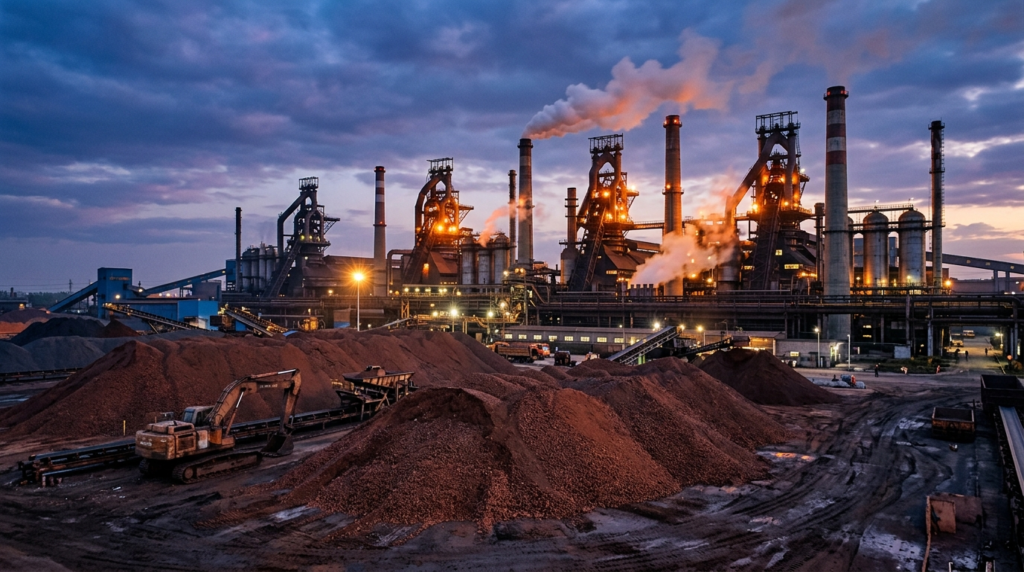
The iron ore price held near the $100 mark this week. However, the market showed clear signs of softening demand. China’s blast furnace operating rate eased to 89% recently. That drop reflects weaker steel production across Chinese mills. In other words, the world’s top steelmaker is pulling back.
The benchmark price data tells the story clearly. The Mysteel 61% Fines Index sat at $95.85 per tonne. That marked a fall of $1.50 on the day. On the Dalian exchange, futures traded at 718 yuan. That represented a decline of 1.71% for the session. In addition, related mining stocks slipped on the news.
China’s steel production numbers explain the pressure. The blast furnace operating rate reached 89.08% overall. That figure fell 0.48 percentage points week on week. Daily pig iron output dropped to 2.4028 million tonnes. That was 5,200 tonnes lower than the prior week. Consequently, demand for imported ore weakened further.
The reason behind the cuts is largely financial. Chinese steel margins have turned negative for many mills. Negative margins force producers to reduce output rather than expand. Lower production means mills buy less raw iron ore. Therefore, the price faces steady downward pressure. In other words, weak steel economics drive weak ore demand.
China’s role in this market cannot be overstated. The country consumes roughly 75% of global seaborne iron ore. Any shift in Chinese demand moves the entire market. As a result, Latin American exporters watch China closely. Brazil’s producers are especially sensitive to these swings.
That sensitivity showed clearly in the equity markets. Vale’s New York-listed shares fell 1.04% to $15.28. Brazilian-listed producers dropped even more sharply on the day. By contrast, diversified miner Rio Tinto gained 0.57%. Its broader portfolio cushioned the impact of ore weakness. In other words, focused ore producers felt the most pain.
The longer-term outlook adds to the caution. Vale CEO Gustavo Pimenta made a striking comment in June. He said China has likely hit peak crude steel production. That peak sits above 1 billion metric tonnes annually. If true, it signals structural demand headwinds ahead. Additionally, it challenges the growth assumptions of ore exporters.
For B2B audiences, these signals matter well beyond mining. Steel prices feed directly into construction and manufacturing costs. Automakers, builders, and machinery firms all track ore trends. Falling steel output can ease input costs for buyers. However, it can also signal a slowing industrial economy.
The picture also connects to broader Chinese demand weakness. Several sectors have shown softer Chinese consumption this year. B2BInside covered how Toyota's China sales fell 24.3% recently. Both stories point to cooling demand inside China. In other words, the iron ore slide fits a wider pattern.
Buyers of steel and raw materials must plan carefully now. Price swings complicate budgeting for manufacturers and traders. Reliable sourcing helps firms manage this volatility better. Global B2B marketplaces such as Industrytc connect material buyers and suppliers. Such platforms help firms compare offers across regions quickly.
The market remains finely balanced for now. The iron ore price is holding despite the demand dip. Supply discipline among major miners supports current levels. Additionally, any Chinese stimulus could quickly change the picture. Steel demand often responds fast to policy shifts.
Ultimately, the easing blast furnace rate is a warning sign. It shows Chinese steel appetite cooling in real time. Whether prices hold near $100 depends on China. Mills will only buy more ore if margins recover. For now, caution defines the iron ore market.
Traders and manufacturers will monitor Chinese data closely. Weekly furnace rates offer an early demand signal. In addition, steel margins reveal when buying may resume. The next few weeks should clarify the trend. For now, softer demand keeps the market subdued.
The supply side adds another layer to watch. Major miners have kept output broadly steady this year. Brazil and Australia dominate global seaborne supply. Stable supply meeting weaker demand pressures prices further. However, no producer wants to trigger a price collapse. Consequently, some may trim shipments to defend prices.
The peak steel debate could reshape long-term planning. If China has truly peaked, exporters must adapt. Miners may shift focus toward higher-grade ore. Cleaner steel production favours better quality inputs. Additionally, some producers are eyeing other growth markets. India, for example, is expanding its own steel output. In other words, the demand map is slowly changing.
For manufacturers, the trend offers a mixed outlook. Cheaper steel could lower costs for many products. Construction, machinery, and appliances all use large volumes. Yet weaker Chinese demand hints at slower global growth. Therefore, buyers should welcome lower prices cautiously. In addition, they must watch for wider economic signals.
The market also reflects bigger structural change in China. The country is shifting away from heavy construction. Property sector weakness has cut steel demand sharply. Infrastructure spending no longer grows as fast as before. Consequently, steel intensity in the economy is falling. In other words, China’s growth model is evolving.
That evolution matters for the entire commodity world. Iron ore was central to China’s building boom. A maturing economy needs proportionally less steel. Exporters must therefore plan for flatter demand. Additionally, they may seek new customers in emerging markets. Ultimately, the iron ore era of endless growth is fading.