By B2B Business Desk
The Sensitive Price Index rose 9.66% year-on-year for the week ended July 23, 2026. Six months ago, that number sat near zero. Twelve months before that, it touched 38%. Households are hedging with gold, one reason Pakistan’s PKR 4,000 gold price increase is hitting businesses.
Pakistan’s inflation cycle doesn’t move in a straight line. It moves in a shape. And that shape is now repeating for the second time in three years.
Here are the Numbers
Arif Habib Limited’s weekly SPI release tracks 51 essential items across 17 cities: wheat, chicken, LPG, diesel, onions, the goods that determine whether a household’s month gets easier or harder. The data for the week ended July 23:
| Quintile | 23-Jul-26 | 16-Jul-26 | WoW | 24-Jul-25 | YoY |
|---|---|---|---|---|---|
| Q1 | 349.80 | 346.78 | 0.87% | 317.34 | 10.23% |
| Q2 | 351.58 | 348.49 | 0.89% | 317.42 | 10.76% |
| Q3 | 371.94 | 368.99 | 0.80% | 340.39 | 9.27% |
| Q4 | 358.68 | 355.62 | 0.86% | 328.38 | 9.23% |
| Q5 | 358.89 | 355.40 | 0.98% | 328.92 | 9.11% |
| Combined | 360.88 | 357.61 | 0.91% | 329.09 | 9.66% |
Every income quintile moved in the same direction. Q5, the lowest-income group, posted the sharpest week-on-week gain at 0.98%. That’s not a rounding artifact. Lower-income households spend a larger share of budget on food and fuel, the two categories driving this print. When the SPI accelerates evenly across quintiles but hits hardest at the bottom, the inflation is coming from the grocery aisle and the petrol pump, not from housing or discretionary spend.
The Historical Analogy
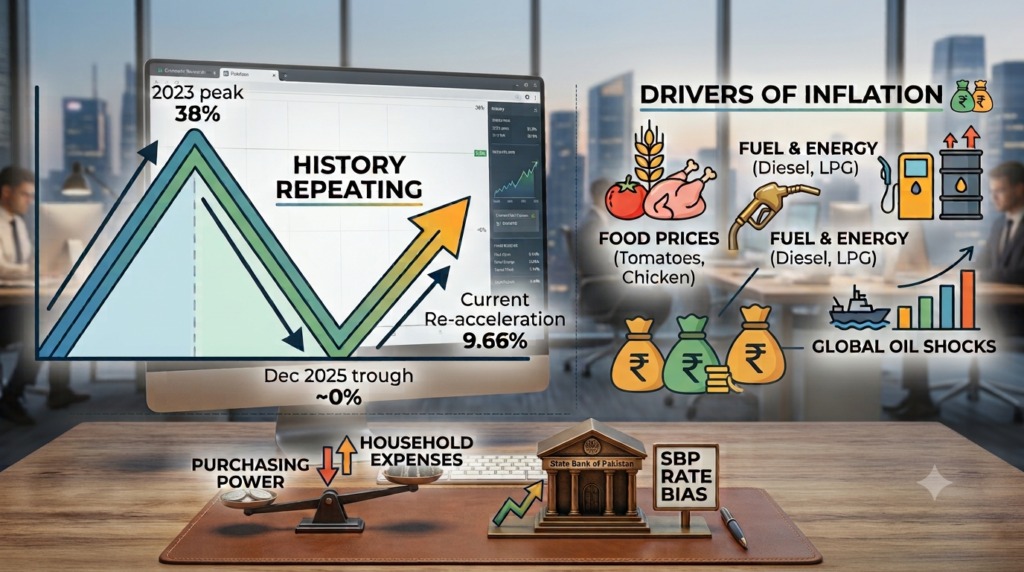
Plot the SPI’s year-on-year trend from September 2025 forward and one pattern jumps out: a trough near zero in December 2025, then an unbroken climb to roughly 15% by June 2026, then a slight pullback to today’s 9.66%.
That’s a smaller, faster echo of 2022–2023. Pakistan’s CPI cleared 38% in early 2023, the highest reading in 49 years, driven by currency depreciation, an IMF-mandated subsidy unwind, and an energy price shock. Inflation then fell for two straight years, bottoming under 1% through most of 2025 as base effects flattered the comparison.
Base effects always mean revert. A low print twelve months ago makes the current print look larger, even if nothing has structurally changed. That mechanical unwind is most of what happened between December 2025 and June 2026. The SPI didn’t discover a new inflation problem. It ran out of an artificially low base to compare against.
The distinction matters for anyone pricing risk in Pakistan right now. A base-effect climb is temporary and self-correcting within twelve months. A structural climb, the kind driven by currency weakness or fiscal slippage, compounds. The July data offers the first read on which one this is: SPI eased from June’s 12.8% to 9.66%. That’s the base effect fading, not a new shock building.
The Scale Problem
A 9.66% annual increase sounds abstract until it’s translated into a household’s cash flow. Pakistan’s SPI basket weights food and energy heavily by design, precisely because those categories are what a typical household actually buys week to week. A 9.66% rise on that basket, compounding on top of the 38% peak from three years prior, means the SPI combined index is up roughly 41% since 2023 lows. A basket that cost 255 rupees in early 2023 costs closer to 360 rupees today. The backdrop tempers hopes pinned on Google’s first Pakistan office.
That’s the number policymakers watch and the number the State Bank of Pakistan has priced into its rate decisions. The SBP held its policy rate at 11.5% through its last several meetings, after a single 100-basis-point hike in April 2026, the first increase in nearly three years. A central bank that just finished an easing cycle doesn’t want to reverse it. But a re-accelerating SPI, even one explained mostly by base effects, is exactly the kind of print that keeps a hiking bias alive.
What the Weekly Detail Tells You that the Headline Doesn’t
The July 16 SPI release, the week before this one, showed the mechanism directly: tomatoes up 22.79% week-on-week, chicken up 14.66%, LPG up 12.46%, diesel up 4.41%. Those are perishables and energy, the two most volatile lines in any price index and the two least responsive to monetary policy. The State Bank can raise rates until inflation cools demand-driven categories, but it cannot make tomatoes cheaper. When SPI moves are concentrated in weather-sensitive food and administered energy prices, rate policy is a blunt instrument aimed at the wrong target.
The External Shock: An Import Bill Pakistan Doesn’t Control
The energy line in that basket carries a second driver that has nothing to do with Pakistan’s domestic economy: renewed US-Iran hostilities over the Strait of Hormuz. Fighting between the two escalated again through mid-to-late July 2026, pushing Brent crude above $90 a barrel and US pump prices above $4 a gallon for the first time in over a month, as tanker traffic through the Strait, the corridor for roughly a fifth of global oil supply, came under direct threat. Every barrel that gets more expensive in that conflict lands on Pakistan’s import bill within weeks, since Pakistan imports the large majority of its refined fuel and crude.
That’s a materially different inflation source than tomatoes and chicken. A vegetable price spike self-corrects with the next harvest. A Strait of Hormuz risk premium doesn’t self-correct on a harvest calendar. It corrects only when the conflict de-escalates, or it compounds if the conflict widens; Brent already touched the low-$100s during the acute phase of the same US-Iran war back in March 2026. Diesel’s 4.41% weekly jump in the July 16 SPI print isn’t noise. It’s the transmission mechanism: diesel prices feed directly into transport costs for every perishable good in the basket, which is part of why food and fuel are moving together rather than independently right now.
For Pakistan specifically, the exposure runs two ways. Higher global crude widens the import bill and pressures the rupee, and a weaker rupee makes every dollar-denominated import, including the fuel itself, more expensive in local currency. That’s the same feedback loop that helped drive the 2023 spike to 38%, currency and energy reinforcing each other. The scale is smaller this time, the starting point is lower, and the government has more fiscal buffer than it did in 2023. But the mechanism is the same, and it’s currently live and outside Islamabad’s control.
Overall Findings
Pakistan’s SPI is not signaling a return to 2023. It’s signaling that the base-effect tailwind which flattered every reading from January through June 2026 has started to fade, and the underlying run rate, roughly 9–10% year-on-year on food and energy, is what remains once that tailwind is gone. That run rate is the real number to underwrite against for the next two quarters, not the trough of December 2025 and not the peak of June 2026.
For anyone modeling Pakistani consumer demand, import costs, or wage-pressure exposure, the operating assumption should be a high single-digit to low double-digit SPI run rate through year-end, with the US-Iran conflict as the primary external swing factor, domestic food supply as the secondary one, and monetary policy as a tertiary, slower-acting lever. Watch the Strait of Hormuz before watching the State Bank.
Sources: Pakistan Bureau of Statistics (PBS), Arif Habib Limited (AHL) Research, weekly SPI release for the week ended July 23, 2026. Global crude and US pump price figures per Reuters, Al Jazeera, and Forbes reporting, July 2026. Export sectors offer some relief, such as the 41% surge in Pakistani seafood exports.