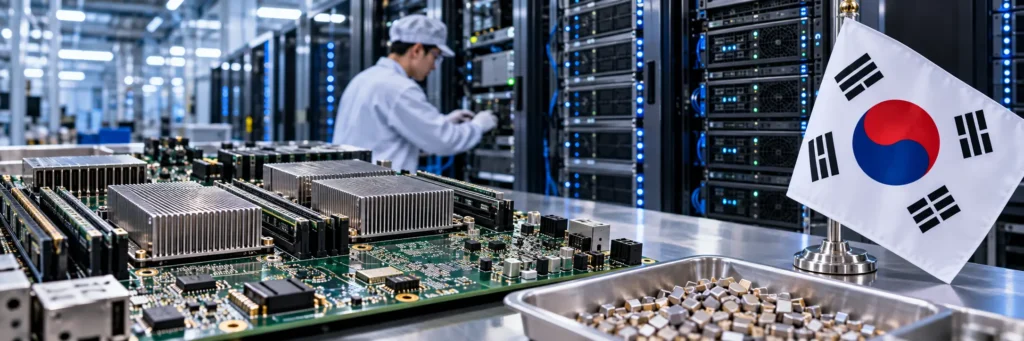
Samsung Electro-Mechanics is turning the AI boom into a long order book. The Korean parts maker has now disclosed about 3.6 trillion won in 2026 deals. That equals roughly $2.6 billion in advance orders. Most contracts cover parts for AI servers, with deliveries stretching into 2027 and 2028.
The latest deal landed on October 2. It is worth 290 billion won and covers MLCCs and inductors. In other words, Samsung Electro-Mechanics AI server orders keep stacking up. Additionally, buyers are locking in supply years ahead of delivery.
Key Takeaways
- Samsung Electro-Mechanics has disclosed about 3.6 trillion won ($2.6B) in 2026 deals.
- The newest deal, signed October 2, is worth 290 billion won.
- Most orders cover MLCCs, inductors, and silicon capacitors for AI servers.
- Deliveries run mainly from 2027 into 2028.
- Customers are unnamed global big tech firms.
A Year of Record Supply Deals
The company has signed several large contracts since spring. Each one targets the power and signal needs of AI hardware. Together, they show how fast data center demand is reshaping component markets.
- May 2026: Silicon capacitor contract worth 1.56 trillion won, to be supplied from 2027 to 2028.
- June 2026: MLCC supply deal worth about 454 billion won.
- September 1, 2026: MLCC contract worth 1.07 trillion won (about $790 million).
- October 2, 2026: MLCC and inductor deal worth 290 billion won.
The company has not named its customers. Korean media describe them only as global big tech firms. Therefore, buyer identities remain unconfirmed.
Why AI Servers Need These Parts?
AI servers draw far more power than standard machines. That makes stable power delivery essential. The parts below solve that problem at the chip level.
MLCCs and Inductors
Multilayer ceramic capacitors, or MLCCs, store and release small amounts of energy. They smooth power flow to processors and memory. AI servers use far more MLCCs than conventional servers. Inductors work alongside them to regulate current.
As a result, every new AI rack lifts demand for these tiny parts. High-capacity, high-temperature MLCCs are especially scarce. In other words, the AI server MLCC demand cycle favours established suppliers.
Silicon Capacitors and Substrates
Silicon capacitors sit very close to the chip package. They reduce power noise in advanced AI accelerators. The May contract made silicon capacitors the company’s single largest deal this year.
Packaging substrates face similar pressure. Lead times for FC-BGA substrates have reportedly stretched to 48 to 56 weeks. Normal lead times are closer to 12 weeks. Consequently, buyers are ordering earlier to secure capacity.
Pricing Power Shifts to Suppliers
Tight supply is changing the balance between buyers and sellers. Analysts say customers now accept higher prices to guarantee volume. Hana Securities analyst Kim Min-kyung cited buyers’ “high price tolerance” in this market. Such pricing supports margins for leading component makers.
Competition in this market remains concentrated. Japan’s Murata is widely seen as the global MLCC leader. Samsung Electro-Mechanics is generally ranked as its closest rival. Long-term AI contracts could help narrow that gap.
Additionally, the company is expanding capacity to meet demand. It has outlined major investments at its Sejong site in Korea and in Vietnam. These plans aim to ease the AI server components shortage over time.
B2B Buyers and the Global Market
The AI supply chain now runs on long-term contracts. Server makers, distributors, and electronics buyers face tighter allocation. Smaller buyers may find spot supply limited and costly.
For procurement teams, supplier diversity has become critical. A global B2B marketplace helps buyers find verified electronics component suppliers. Such platforms widen sourcing options when major vendors are sold out. That reach matters as lead times stretch.
This story fits a wider hardware squeeze. B2BInside recently covered the AI data center boom and global memory chip shortage. Server demand is also lifting hardware makers. Our report on Lenovo’s record $26.9 billion quarter shows that effect.
Will the orders continue due to high demand in the market?
The order book looks strong through 2028. However, AI spending cycles can shift quickly. A slowdown in data center building would test these contracts.
Ultimately, Samsung Electro-Mechanics has secured visibility few rivals enjoy. Its deals lock in volume and support pricing. For now, Samsung Electro-Mechanics AI server orders signal deep, sustained demand.
Frequently Asked Questions (FAQs)
Disclosed deals total about 3.6 trillion won this year. That equals roughly $2.6 billion. Most deliveries run from 2027 into 2028.
MLCCs are tiny capacitors that store and release energy. They stabilise power for processors and memory. AI servers need far more of them than standard servers.
The company has not named them. Reports describe them as global big tech firms. Their identities remain undisclosed.
The May silicon capacitor deal was the largest. It was worth 1.56 trillion won. Supply runs from 2027 to 2028.
Demand for AI accelerators has outpaced substrate capacity. FC-BGA lead times have reportedly reached 48 to 56 weeks. Normal lead times are about 12 weeks.
Japan’s Murata is widely seen as the market leader. Samsung Electro-Mechanics is generally ranked second. AI server demand is lifting both companies.