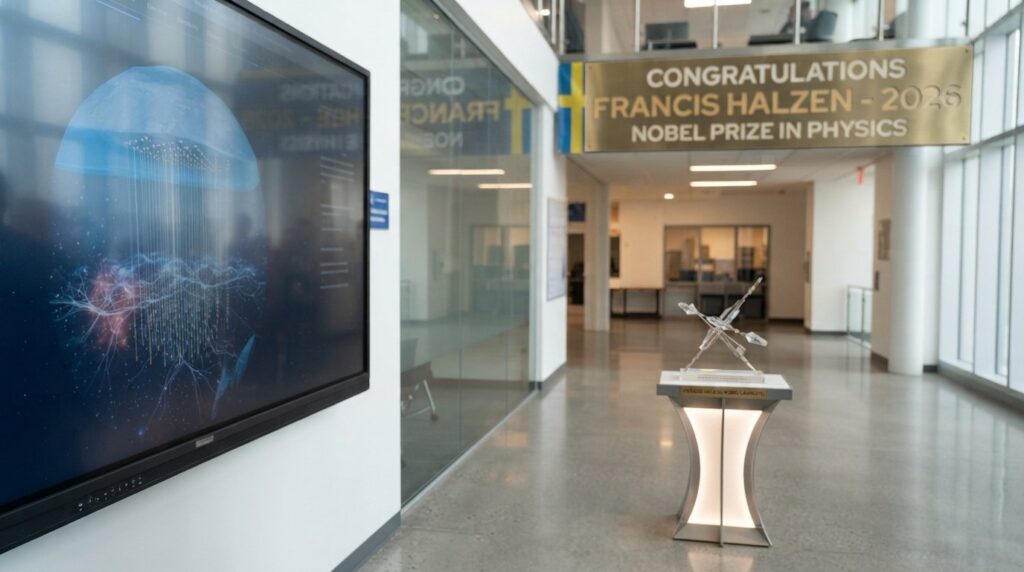
- Francis Halzen won the 2026 Nobel Prize in Physics for detecting high-energy astrophysical neutrinos, announced on October 6, 2026.
- His work led the IceCube Neutrino Observatory, which uses a cubic kilometer of Antarctic ice to catch faint flashes from rare neutrino impacts.
- The prize puts neutrino astronomy in the spotlight and highlights multi-messenger astronomy, which combines several types of cosmic signals.
- Francis Halzen — Nobel laureate who led the IceCube effort
- Royal Swedish Academy of Sciences — announced the 2026 award
- University of Wisconsin-Madison — institution that operates IceCube
The 2026 Nobel Prize in Physics has a winner. Francis Halzen took the honor. The Royal Swedish Academy of Sciences made the call. The award came on October 6, 2026. Halzen won for detecting high-energy neutrinos. These are rare “ghost particles” from space. He led this work at the IceCube Observatory. The 2026 Nobel Prize in Physics rewards decades of effort.
Halzen is a Belgian-born physicist. He works at the University of Wisconsin-Madison. He has guided IceCube for years. The detector sits deep in Antarctic ice. It captures signals from distant cosmic events. The prize puts neutrino astronomy in the spotlight. The win also honors a huge team. IceCube involves many institutions worldwide. Hundreds of researchers support the work. So the prize reflects a global effort. For science, it is a proud moment.
The Award in Short
- The 2026 Nobel Prize in Physics went to Francis Halzen.
- The Royal Swedish Academy announced it on October 6, 2026.
- The work detected high-energy astrophysical neutrinos.
- The research used the IceCube Neutrino Observatory.
- IceCube is buried in ice at the South Pole.
Who won the 2026 Nobel Prize in Physics
Francis Halzen is the sole focus of the award. He pioneered the hunt for cosmic neutrinos. These particles rarely interact with matter. So they are very hard to detect. Halzen helped design a bold solution. He turned Antarctic ice into a giant detector. The official Nobel Prize site confirms the award. The win marks a milestone for particle physics. Halzen long championed this bold idea. Early on, few thought it would work. Catching neutrinos seemed almost impossible. Yet the IceCube team proved otherwise. Their success reshaped a whole field. In other words, persistence changed the science.
What the research discovered
The prize rewards a simple but deep idea. Neutrinos carry clues from the universe. Yet they slip through almost everything. Catching them needed a new approach. The two points below explain the science.
Neutrinos, the ‘ghost particles’
Neutrinos are tiny subatomic particles. They have almost no mass. They rarely touch other matter. Billions pass through you each second. So scientists call them ghost particles. Their faint signals are hard to read.
How the IceCube Observatory detects them
IceCube uses a cubic kilometer of ice. Sensors sit deep below the surface. A rare neutrino sometimes hits the ice. That impact creates a faint flash of light. The sensors record these flashes. From them, scientists trace cosmic sources. IceCube is operated through the University of Wisconsin-Madison.
Why neutrino astronomy matters
Neutrino astronomy opens a new window. Light alone cannot reveal everything. Many cosmic events hide behind dust and gas. Neutrinos cut straight through them. So they carry unique information. The main reasons it matters include:
- Neutrinos travel the cosmos almost undisturbed.
- They reveal violent events light cannot show.
- They enable multi-messenger astronomy.
In addition, the field blends many disciplines. Physics, engineering, and computing all contribute. Neutrinos also reach us from far away. They come from black holes and bursts. Such sources are hard to study. Light often gets blocked on the way. Neutrinos avoid that problem entirely. So they add a new layer of data.
Decades of work behind the prize
This success did not come quickly. Halzen worked on the idea for years. Building IceCube took huge effort. The site sits in a harsh climate. Teams drilled deep into the ice. They placed thousands of sensors with care. Heavy computing also powers the analysis. Ultimately, patience and scale paid off.
The 2026 Nobel Prize in Physics in context
The award fits a wider trend. Big science now relies on big tools. Detectors and telescopes keep growing. They need advanced sensors and computing. Powerful hardware drives modern research. The 2026 Nobel Prize in Physics honors that model. In other words, teamwork and technology won together.
How IceCube changed astronomy
IceCube opened a fresh observing method. Scientists no longer rely on light alone. They can track neutrinos instead. This approach is called multi-messenger astronomy. It combines several types of signals. Together, they paint a fuller picture. The field has grown quickly since. The 2026 Nobel Prize in Physics reflects that growth. It also sets a path for future work.
What this means for science and industry
Fundamental science also feeds industry. Detector projects need specialized parts. Sensors, cables, and optics all matter. Precision electronics are in high demand. Firms that supply these tools benefit. Research buyers can find vetted vendors on a B2B marketplace. That shortens the path from lab to supplier. In addition, frontier research inspires new engineering. Space-engineering ventures are expanding too. Universities often partner with industry. They co-develop sensors and software. Startups then commercialize the results. So basic science spreads outward. It creates jobs and new tools.
What does the award mean for the future?
The prize should boost the field. More students may study neutrinos. More funding may follow the attention. New detectors could be larger still. Ultimately, neutrino astronomy looks set to grow. The universe still holds many secrets. Tools like IceCube will help reveal them. Bigger detectors may come next. New sites are already proposed. More data will sharpen the science. Young researchers will lead it forward.
Frequently Asked Questions (FAQs)
He won for detecting high-energy astrophysical neutrinos. The work used the IceCube Observatory in Antarctica.
Ghost particles is a nickname for neutrinos. They rarely interact with matter, so detection is hard.
It is a detector built into Antarctic ice. Sensors capture light from rare neutrino impacts.
The Royal Swedish Academy announced it on October 6, 2026.
Neutrinos cross the cosmos almost undisturbed. They reveal events that light cannot show.
IceCube sits at the South Pole. It is built into deep Antarctic ice.