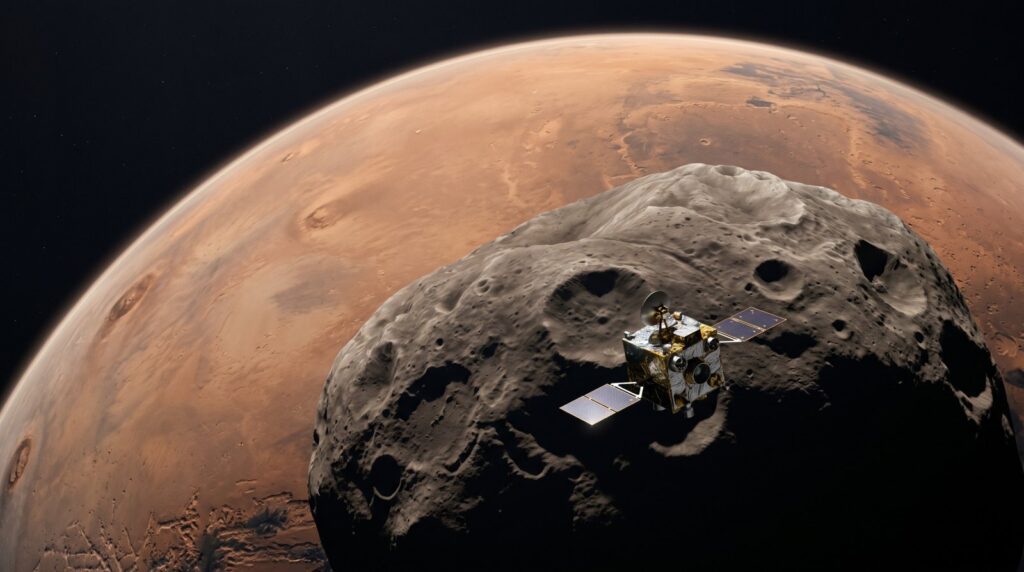
- Japan's MMX mission launched on an H3 rocket on October 19, 2026, bound for Phobos, a moon of Mars.
- Led by JAXA, it aims for the first-ever Phobos sample return and carries the French and German Idefix rover.
- A Phobos sample could help settle how the Martian moons formed and builds sample-return skills for future missions.
- JAXA — Japan's space agency, leads the mission
- CNES and DLR — French and German agencies behind the Idefix rover
- ESA — shared images of the liftoff
Japan has launched a bold space mission. The Japan MMX mission is now underway. MMX stands for Martian Moons eXploration. It aims for Phobos, a moon of Mars. The spacecraft rode an H3 rocket to space. JAXA leads the mission. The launch took place on October 19, 2026. That was October 20 in Japan time. The probe carries a small rover. The rover is called Idefix. France and Germany built it together. The goal is a first for science. The Japan MMX mission wants to return a Phobos sample.
No mission has returned a Mars moon sample before. So this attempt is historic. It could reveal how the moons formed. For the space sector, the stakes are high.
Mission Snapshot
- The Japan MMX mission targets Phobos, a moon of Mars.
- It launched on an H3 rocket on October 19, 2026.
- JAXA leads the mission.
- It carries the French and German Idefix rover.
- The goal is a first-ever Phobos sample return.
What Japan’s MMX mission is
MMX is a sample-return mission. It belongs to Japan’s space agency, JAXA. The spacecraft will travel to Mars. There it will study the two moons. It will focus mainly on Phobos. The plan is to collect surface material. Then it will bring that sample home. ESA shared images of the liftoff. The Japan MMX mission is a long journey. It needs years to finish. In short, it is a patient, high-risk quest.
Mission goals and hardware
The mission pairs clear goals with smart hardware. Both parts drive its value. The spacecraft must survive deep space. It must also land briefly on Phobos. The two points below add detail.
The Idefix rover
Idefix is a small, clever rover. France and Germany built it. The agencies are CNES and DLR. The rover will explore Phobos up close. It will study the surface in detail. Space.com covered the mission plan. So the rover adds ground-level data. It supports the main spacecraft.
The sample-return plan
The core goal is a sample return. MMX will touch Phobos briefly. It will grab surface material. Then it will store the sample safely. The spacecraft will later head home. Nippon.com reported the launch. A safe return would be a milestone. It would give scientists real Phobos rock.
Why the Japan MMX mission matters
A Phobos sample is scientifically rich. It could settle a long debate. The moons’ origin remains unclear. Samples may provide the answer. The key reasons include:
- It targets a first-ever Martian moon sample return.
- It could reveal how the moons formed.
- It builds on strong international teamwork.
In addition, it advances sample-return skills. Those skills help future missions too.
Years in the making
MMX did not come together quickly. JAXA planned it for years. Engineers solved many hard problems. Deep-space travel is unforgiving. Landing on a tiny moon is tricky. Space-engineering ventures keep growing. Partners added rover expertise too. Ultimately, patience shaped the mission. The launch marked a proud moment.
How MMX compares to past Mars missions
Many missions have studied Mars. Rovers roam the planet’s surface. Orbiters map it from above. Yet few have targeted the moons. Fewer still aim to return samples. So MMX breaks new ground. It focuses on Phobos directly. It also plans a round trip. In addition, it blends several nations’ work.
The technology behind the mission
MMX relies on advanced systems. The H3 rocket provided the lift. Precise navigation guides the probe. Sampling tools must work flawlessly. Advanced tech services keep expanding. Communication links span vast distances. Power and thermal systems are vital. So every part must perform. In short, the mission is a tech showcase. Autonomy is key for the probe. Mars is far from Earth. Signals take minutes to arrive. So the craft must act alone. Onboard software guides each step.
What the mission means for the space industry
Deep-space missions need many suppliers. They use sensors, alloys, and electronics. They also need ground support systems. So the supply base is wide. Autonomous and robotics firms are scaling too. Firms that make space-grade parts can connect on a B2B marketplace. That links makers with verified buyers. In addition, such missions inspire new engineers. The talent pipeline grows as a result.
What to watch next
The journey to Mars is long. The probe must cruise for years. Key moments lie ahead. The Phobos approach is critical. The sampling step is the big test. Then the return trip begins. So patience will be needed. Ultimately, success depends on each phase. For now, the launch looks promising.
What would a Phobos sample tell us?
A sample could answer big questions. It may reveal the moon’s origin. It could show links to Mars itself. It might even hint at the early solar system. Still, the mission has far to go. Risks remain at every stage. In short, the science could be huge. The wait will be worth it.
Frequently Asked Questions (FAQs)
It aims to study Mars’ moons. It will return the first Phobos sample.
The mission launched on Japan’s H3 rocket. JAXA operates the mission.
It is a small French and German rover. It will explore the surface of Phobos.
It launched on October 19, 2026. That was October 20 in Japan time.
Phobos may hold clues to its origin. A sample could settle that debate.
JAXA leads the mission. CNES and DLR contributed the Idefix rover.
The round trip takes several years. The exact return depends on the mission plan.