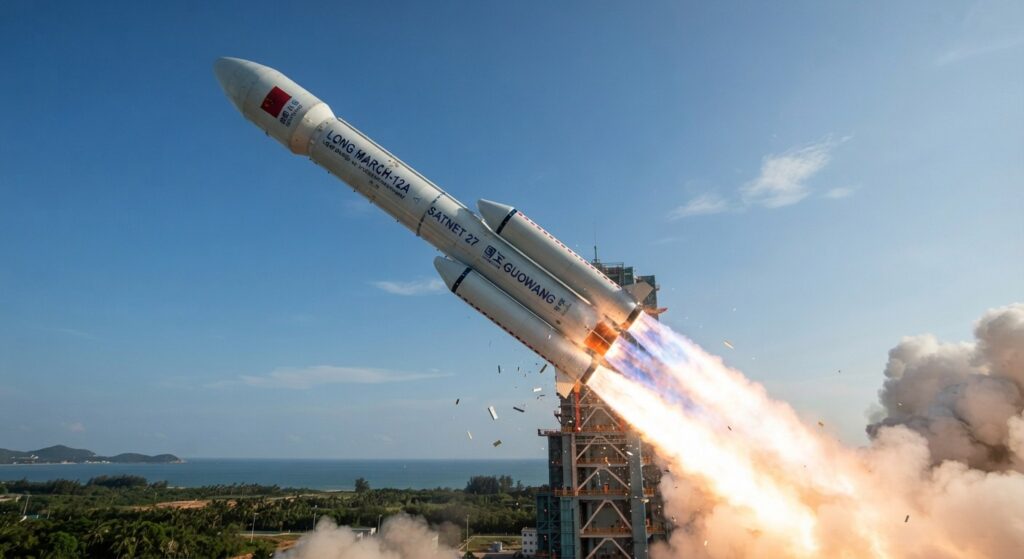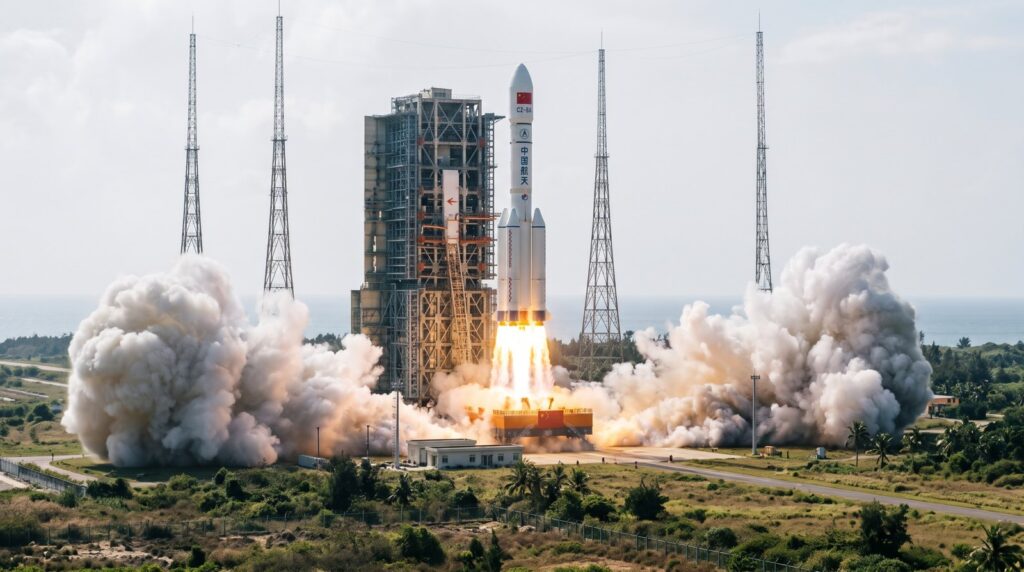
- The Long March 8A launch on October 25, 2026, lifted the 28th group of low-orbit internet satellites from Wenchang, Hainan, at 10:03 Beijing time.
- The satellites join the Guowang/SatNet constellation, which aims to cover China and may reach global users.
- Each group adds capacity and keeps China in the global LEO race while growing demand across the space supply chain.
- Guowang/SatNet — China's LEO broadband constellation
- Long March 8A — rocket that carried the 28th group
- Xinhua — reported the successful launch
China has sent up more internet satellites. The China Long March 8A launch took place on October 25, 2026. It lifted off from Wenchang, in Hainan. The flight carried the 28th group of satellites. These are low-orbit internet satellites. They join the Guowang network. Some also call it SatNet. The liftoff came at 10:03 Beijing time. That was 02:03 in UTC. The China Long March 8A launch keeps the buildout moving fast. For the space sector, the cadence is striking.
China is racing to fill its network. Each launch adds more coverage. So the constellation keeps growing. The pace shows strong commitment. The goal is wide broadband from space. Space-based internet is a fast field. Many nations now invest heavily. So the race keeps intensifying.
Launch Snapshot
- The China Long March 8A launch happened on October 25, 2026.
- It carried the 28th group of low-orbit internet satellites.
- The site was Wenchang, in Hainan.
- Liftoff came at 10:03 Beijing time.
- The satellites join the Guowang/SatNet constellation.
What the China Long March 8A launch delivered
The flight added more satellites to orbit. They support space-based broadband. The 28th group follows many before it. So the network keeps expanding. Low-orbit units cut signal delay. That helps with fast connections. Xinhua reported the successful launch. The China Long March 8A launch stayed on schedule. In short, the buildout continues apace.
Inside the mission
The mission paired a proven rocket with a clear goal. Both parts matter here. The launcher is built for such work. The payload joins a national network. The two points below add detail.
The Long March 8A rocket
The Long March 8A is a capable launcher. It suits batch satellite missions. So it fits constellation work well. Reliable rockets keep the pace high. China Daily covered the launch. Frequent flights help China scale fast.
The Guowang/SatNet constellation
Guowang is a large network. It is also known as SatNet. It aims to cover the whole country. It may reach global users too. Many satellites work as one web. Launch trackers logged the mission. Each group strengthens the system.
Why the Long March 8A launch matters
Space-based internet is strategic. It reaches remote and rural areas. It also supports ships and planes. So the stakes are high. The main reasons include:
- It continues a steady constellation buildout.
- It expands space-based broadband reach.
- It secures a place in the global LEO race.
In addition, the network enables new services. Many sectors can benefit.
The Guowang buildout continues
A megaconstellation needs many launches. One flight is never enough. So China launches in rapid batches. This 28th group shows the cadence. Space-engineering ventures are growing worldwide. Ultimately, each launch adds capacity. Over time, the pieces form a full web. The pace keeps accelerating. Factories now mass-produce satellites. That speeds the whole program. So launches can happen often.
How it fits the global LEO race
Several nations build LEO networks. The race is global and fast. Lower launch costs fuel the push. More players can reach orbit now. Advanced tech services keep expanding. So competition stays intense. China aims to hold a strong share. Timing and scale both matter here. Early movers claim good orbits. They also win key spectrum. So speed brings real advantage. In addition, scale lowers costs. Global demand for connectivity grows. Remote regions need better access. So many networks are rising. In addition, data use keeps climbing.
What the buildout means for the space supply chain
Big constellations need many parts. Satellites use sensors and antennas. Rockets need engines and avionics. Ground stations need steady hardware. So the supply base keeps growing. Autonomous and robotics firms are scaling too. Part makers can connect on a B2B marketplace. That links makers with verified buyers. In addition, the boom supports many jobs. Quality control stays strict here. Space parts face harsh conditions. So trusted vendors earn repeat orders. In addition, testing adds real cost.
What to watch next
Expect more groups in coming weeks. The cadence should stay high. New services may follow full coverage. Pricing and access will shape adoption. Ultimately, scale decides the outcome. The network must reach enough users. For now, the buildout looks relentless. Costs per satellite should fall. Mass production drives that trend. Reusable rockets may join later.
How close is China’s LEO network to completion?
The pace is clearly fast. Each group moves the plan ahead. Yet full coverage needs many more. So completion will take time. In short, momentum stays strong. The next year will reveal progress. For now, China keeps launching.
Frequently Asked Questions (FAQs)
China used a Long March 8A rocket. It launched from Wenchang, in Hainan.
The flight carried the 28th group of internet satellites. They join the Guowang network.
It is China’s low-orbit internet network. It aims to deliver broadband from space.
It occurred on October 25, 2026. Liftoff was at 10:03 Beijing time.
It wants wide broadband coverage. It also seeks strategic communications capacity.
The network grows with each batch. This flight marked the 28th group.