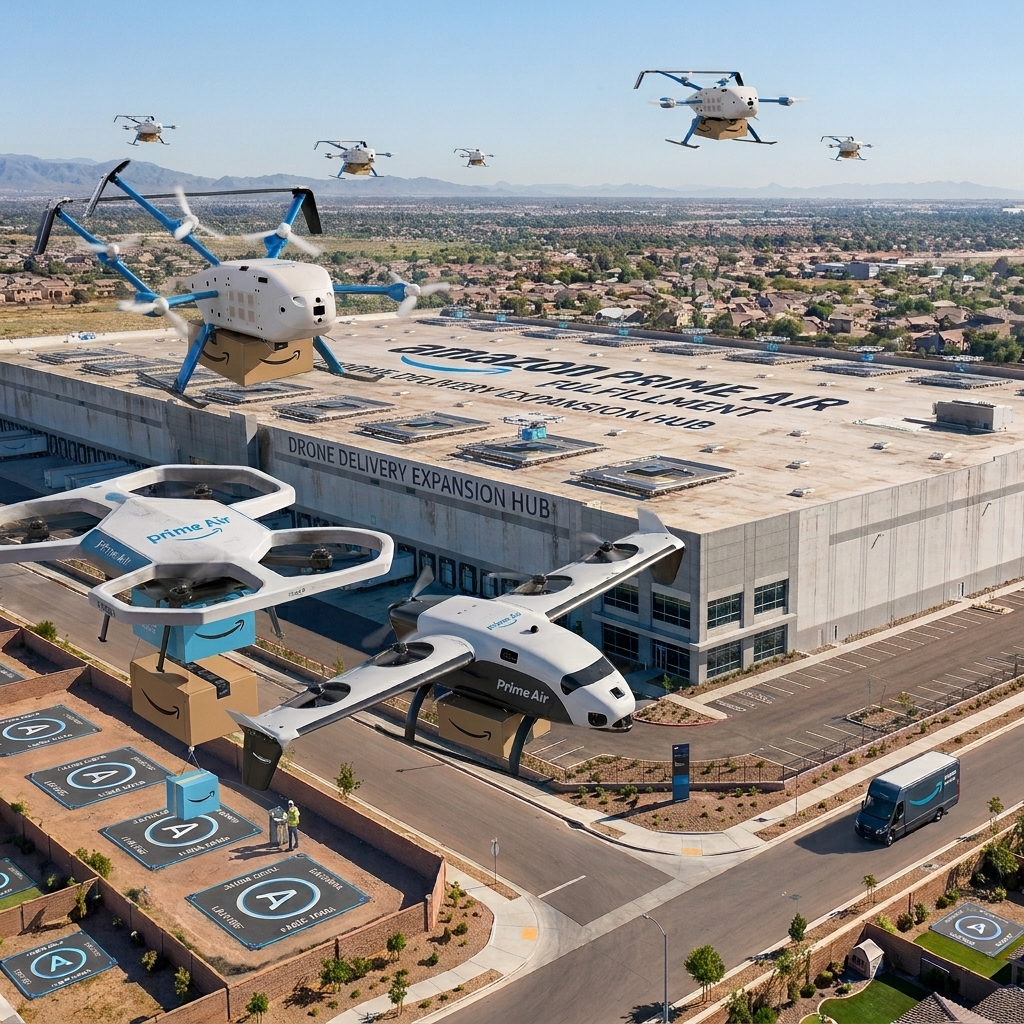
- Amazon plans to expand its Prime Air drone delivery to nearly 500 US cities by the end of 2026, up from 11 current locations.
- Drones can now carry more than 60% of commonly ordered items up to five pounds, signaling a shift from pilot project to mainstream fulfilment channel.
- Amazon is racing Walmart and Google's Wing, with FAA Part 135 certification enabling beyond-line-of-sight flight at scale.
- Amazon — scaling its Prime Air drone-delivery network
- Walmart, Google's Wing — rivals running a competing drone network
Amazon announced this week the 6x growth of its drone delivery program, Prime Air, to serve nearly 500 cities and towns across the United States by the end of 2026, up from the 11 delivery locations currently in 10 metro areas in 7 states. Alexa is coming in response to the demand for fast delivery that Amazon experienced throughout the pandemic, said David Carbon, vice president of the unit, who noted that Amazon has already made hundreds of thousands of deliveries to its customers this year using the drone delivery service.
Where Amazon Prime Air Flies Today — and Next
The current footprint covers Tolleson, Arizona; Ruskin, Florida; Kansas City, Kansas; Baton Rouge, Louisiana; Hazel Park and Pontiac, Michigan; Papillion, Nebraska; and four Texas sites: Richmond, San Antonio, Richardson, and Waco. Amazon says Chicago, Syracuse, Cleveland, Atlanta, and Boise are next, with further launches planned across Georgia, Ohio, Illinois, Idaho, and New York, according to reporting from About Amazon and TechCrunch. Autonomous fleets are multiplying, with Pony.ai’s robotaxi pipeline topping 4,000 vehicles.
The expansion at a glance:
- Live today (11 sites, 7 states): Tolleson, AZ · Ruskin, FL · Kansas City, KS · Baton Rouge, LA · Hazel Park and Pontiac, MI · Papillion, NE · Richmond, San Antonio, Richardson and Waco, TX
- Next up: Chicago · Syracuse · Cleveland · Atlanta · Boise
- Further launches planned: Georgia, Ohio, Illinois, Idaho and New York
- Target: nearly 500 US cities and towns by the end of 2026 — a roughly sixfold increase
What Qualifies for Amazon Drone Delivery
The more interesting figure here isn’t the number of cities where Amazon can fly to, but the amount that qualifies for a drone delivery: Amazon claims that the drones will be able to deliver over 60% of the items customers order more often than not, up to five pounds and about the size of a shoebox in size, ranging from groceries to electronics to cosmetics, to meds and home goods. It’s a materially broader basket than Prime Air had when it launched, and it’s a sign of Amazon drone delivery becoming a fulfillment channel and not a novelty pilot project in the 500+ cities it’s testing in. Global logistics is being reshaped by agile manufacturing too, as when China ships 20,000 Midea AC units to France.
Amazon Prime Air Delivery Pricing
Pricing reflects that shift toward mainstream use. Prime members pay nothing on eligible orders above $50, $2.99 below that threshold, and non-Prime customers pay $4.99, a structure clearly designed to pull drone delivery into Amazon’s existing membership economics rather than treat it as a premium add-on.
| Customer | Order | Delivery fee |
|---|---|---|
| Prime member | Eligible order above $50 | Free |
| Prime member | Below $50 | $2.99 |
| Non-Prime customer | Any eligible order | $4.99 |
FAA Part 135 and Beyond-Visual-Line-of-Sight Flight
The FAA Part 135 drone certification underpinning this expansion is worth flagging for enterprise readers specifically. Part 135 is the same commercial air-carrier certification used for charter operations, and it is the regulatory basis that allows Amazon to fly beyond visual line of sight (BVLOS) at this kind of scale. Combined with what Amazon describes as an industry-leading detect-and-avoid system, the certification effectively unlocks that turns drone delivery from a constrained trial into a nationwide logistics layer, a template other last-mile operators will likely study closely. Delivery is consolidating fast, as Uber closes a $14.8B deal for Delivery Hero.
Amazon Prime Air vs Walmart and Google’s Wing
Amazon is not moving into an empty field. Walmart and Google’s Wing already operate what they describe as the largest unmanned aircraft drone delivery network in the US, having added seven new markets in June 2026. In other words, Amazon’s drone delivery push versus Walmart and Wing is shaping into a genuine infrastructure race between two of the largest US retailers, each betting that sub-hour delivery becomes a meaningful differentiator in grocery and convenience categories specifically. Demand shifts are rattling legacy players elsewhere, such as Toyota’s global sales decline.
Automating the Last Mile
This growth comes amid a larger trend of automating the last mile, a subject that B2B logistics buyers are closely monitoring. This is not Amazon’s only move in this area; a similar move was already made in Germany when Uber acquired Delivery Hero for $14.8 billion, and it’s clear that last-mile delivery consolidation and infrastructure investment are growing across the delivery sector, beyond Amazon. Operators scaling delivery fleets can source logistics and delivery equipment via RFQ.
Furthermore, market researchers at companies like “Fact” are also conducting research. The announcement plays right into the trend line of steady growth in drone logistics estimated by both MR and Grand View Research till early 2030s.
The Real Test: Unit Economics at Scale
Ultimately, the test for Amazon Prime Air will not be the city count itself but whether the unit economics hold at scale, battery costs, airspace coordination, and per-delivery labor all shift materially once a service moves from 11 sites to nearly 500. Amazon’s own projection of roughly 1 million drone deliveries this year, reported by CNBC, gives the first real benchmark for judging whether that transition is working. Automation is remaking retail, including how China is quietly automating British shopping.
Frequently Asked Questions (FAQs)
Amazon plans to expand Prime Air drone delivery to nearly 500 US cities and towns by the end of 2026, up from 11 delivery locations across 10 metro areas in 7 states. That is a roughly sixfold increase and a shift from pilot project to mainstream fulfillment channel.
The current footprint covers Tolleson, AZ; Ruskin, FL; Kansas City, KS; Baton Rouge, LA; Hazel Park and Pontiac, MI; Papillion, NE; and four Texas sites — Richmond, San Antonio, Richardson, and Waco. Chicago, Syracuse, Cleveland, Atlanta, and Boise are next, with further launches planned in Georgia, Ohio, Illinois, Idaho, and New York.
Amazon says its drones can deliver more than 60% of the items customers order most often, up to five pounds and about the size of a shoebox. That basket ranges across groceries, electronics, cosmetics, medicines, and home goods — a materially broader range than at Prime Air’s launch.
Prime members pay nothing on eligible orders above $50 and $2.99 below that threshold, while non-Prime customers pay $4.99. The pricing is designed to pull drone delivery into Amazon’s existing membership economics rather than treat it as a premium add-on.
FAA Part 135 is the same commercial air-carrier certification used for charter operations, and it is the regulatory basis that lets Amazon fly beyond visual line of sight (BVLOS) at scale. Combined with an industry-leading detect-and-avoid system, it turns drone delivery from a constrained trial into a nationwide logistics layer.
Walmart and Google’s Wing already run what they describe as the largest drone delivery network in the US, having added seven new markets in June 2026. The rivalry is shaping into an infrastructure race between two of the largest US retailers over sub-hour grocery and convenience delivery.
Amazon says it has already made hundreds of thousands of drone deliveries this year, and it projects roughly 1 million drone deliveries in 2026, as reported by CNBC. That projection is the first real benchmark for judging whether the economics hold as the service scales from 11 sites to nearly 500.