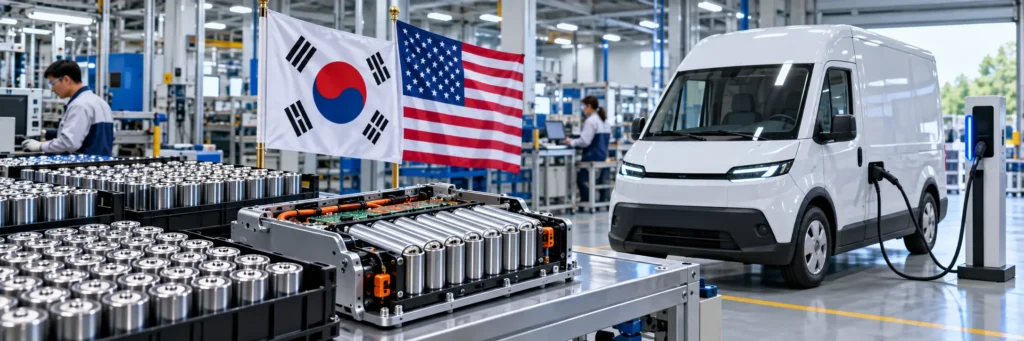
LG Energy Solution has landed a new US customer for its newest battery format. The Korean battery maker signed a memorandum of understanding with Indigo. Indigo is a US startup building electric vans for delivery and ride services.
Under the LG Energy Solution Indigo battery deal, LGES will supply 46-series cylindrical cells. Supply is planned from 2027 to 2030. The cells will come from LGES’s new plant in Arizona. In other words, the deal ties US-made batteries to US-made commercial vehicles.
Some Useful Statistics:
- LGES signed an MOU to supply batteries to US van maker Indigo.
- The deal covers 46-series cylindrical NMC cells.
- Supply is planned from 2027 to 2030.
- Cells will come from LGES’s Arizona plant.
- No value or volume was disclosed.
A Quick Look at the Deal
The agreement is an MOU, not a final binding contract. Neither company disclosed its value or volume. Still, the main terms are clear.
- Partners: LG Energy Solution and Indigo
- Battery type: 46-series cylindrical NMC cells
- Supply period: 2027 to 2030
- Production site: LGES plant in Arizona
- Target vehicles: Indigo’s Flow Cargo delivery van and Flow Ride vehicle
- Deal value: Not disclosed
Kim Nak-jin, a senior vice president at LGES, represented the battery maker. Will Graylin, Indigo’s chief executive, represented the van maker. Additionally, both sides framed the pact as a long-term partnership.
Why do 46-Series Cells matter?
46-series is a newer and bigger cylindrical battery. It’s 46 millimetres in diameter (the “46”). The larger the cells, the more energy they can store and the easier it is to design a battery pack.
Fewer and Simpler Cell Packs
Larger cells equate to fewer vehicles per cell. This decreases the need for wiring, welding, and assembly. This means packaging prices can decrease over time.
It is very beneficial for companies that use vans. Range, durability, and low running costs are required. That is, it is suitable for high-mileage delivery jobs.
Growing Momentum for LGES
LGES has been pushing hard into 46-series production. Its 46-series shipments rose about 50% in the second quarter of 2026. The Indigo deal adds a new commercial customer to that pipeline.
Consequently, the company is diversifying beyond passenger cars. Delivery vans offer steady, fleet-based demand. That demand is less exposed to consumer swings.
The Arizona Factor
The Arizona plant is central to the agreement. LGES aims to start production there by the end of 2026. Local output helps customers meet US sourcing rules.
US-made cells also reduce tariff and shipping risks. Additionally, they shorten delivery times for American vehicle makers. That advantage matters as trade policy grows stricter.
A Fast-Growing Electric Van Market
The electric delivery van market is growing in share. According to one industry forecast, the market is worth $16.3 billion in 2024. Projections are for growth to approximately $65.6 billion by 2034.
Much of that demand comes from last-mile delivery. Online sales continue to rise in urban areas. Hence, fleet electrification provides long-term opportunities for battery suppliers.
B2B Buyers and the Potential Market
Fleet operators and logistics firms watch these deals closely. Battery supply affects van availability and pricing. A secure cell supply can speed fleet electrification plans.
For component buyers, the EV supply chain keeps expanding. A digital B2B platform helps fleet and EV component buyers find verified suppliers worldwide. Such platforms connect buyers with makers of chargers, parts, and battery systems. That reach matters as electrification scales.
This story connects to broader delivery and EV trends. B2BInside covered how Amazon Prime Air is expanding to nearly 500 US cities. Automakers are electrifying premium models too. Our report on Range Rover’s first fully electric model shows that shift.
Will the MOU become a Firm Contract?
MOUs signal intent, not guaranteed orders. Final volumes will depend on Indigo’s production ramp. Startup vehicle makers often face funding and scaling hurdles.
Ultimately, the LG Energy Solution Indigo battery deal shows clear direction. It links new cell technology with US commercial fleets. For now, buyers should watch for a binding supply contract.
Frequently Asked Questions (FAQs)
They will use LGES 46-series cylindrical NMC cells. Supply is planned from 2027 to 2030. The cells will come from Arizona.
It is a large cylindrical cell with a 46-millimetre diameter. It stores more energy per cell. That simplifies battery pack design.
No, it is a memorandum of understanding. It signals intent to supply. Value and volume were not disclosed.
The plant is in Arizona, in the US Southwest. LGES targets production by the end of 2026. It will make cylindrical cells.
One forecast values it at $16.3 billion in 2024. It projects about $65.6 billion by 2034. Last-mile delivery drives that growth.
Indigo is a US electric vehicle startup. It builds the Flow Cargo van and Flow Ride vehicle. Will Graylin is its chief executive.