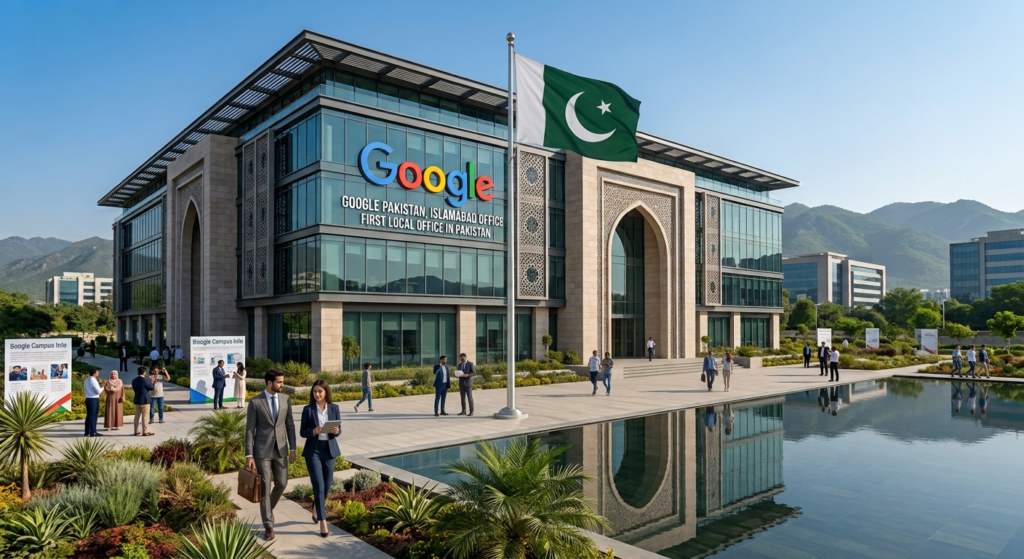
- Google opened its first office in Pakistan, in Islamabad, deepening a decade-long presence as the country targets $30 billion in annual IT exports.
- The company says a decade of activity has added an estimated Rs3.9 trillion to the economy and upskilled over 1 million people, and it will give students a free one-year Gemini subscription.
- The opening reads as both an operational expansion and an economic-confidence signal amid domestic pressure.
- Google — opened its first Pakistan office
- Government of Pakistan — targeting $30 billion in IT exports
As part of its entry into Pakistan, Google inaugurated its first local office in Islamabad on August 18, 2026, alongside a nine-member delegation, led by Wilson White, VP for Government Affairs and Public Policy at Google. It marks a decade-long partnership between Google and Pakistan that the Google Pakistan office officially inaugurates and is a timely move as Islamabad aims to increase the value of IT exports to $30 billion per year.
A Decade-Long Partnership Behind the Google Pakistan Office
White called the moment “a very special moment,” noting that Google has “been investing in and committed to Pakistan for over a decade.” Sharif, in turn, described the inauguration as a “major milestone” and said the government would “empower our youth through these wonderful modern tools, techniques and technology.” The ambition unfolds against a fragile backdrop, as Pakistan’s price index re-accelerates.
The Google Islamabad office inauguration is backed by figures that illustrate the scale of the company’s existing footprint. Over the past ten years, Google’s activities have contributed an estimated Rs3.9 trillion to Pakistan’s economy and supported roughly 960,000 jobs, according to figures reported by Arab News, Geo News, Gulf News, and Dawn. Google has also upskilled more than 1 million Pakistanis through its career-certificate programs, a detail relevant to any company evaluating the country’s growing digital-skills pipeline.
Google’s stated decade-long footprint in Pakistan, by the numbers:
| Metric | Figure |
|---|---|
| Economic contribution (10 years) | ~Rs3.9 trillion |
| Jobs supported | ~960,000 |
| Pakistanis upskilled | 1 million+ via career-certificate programs |
| Student offer | Free one-year Gemini subscription for all students |
| National target | $30 billion/year in IT exports |
Free Gemini for Students: AI Distribution First
Beyond the office opening, Google announced it will provide a free one-year Gemini subscription to all Pakistani students, a commitment separately confirmed by Pakistan Observer and Dunya News. For B2B software vendors and ed-tech providers watching the region, this signals Google is treating Pakistan’s student population as a strategic entry point for AI-tool adoption. AI vendors are opening new revenue streams, as in OpenAI’s new ChatGPT ad market.
Not unlike how enterprise AI rollouts elsewhere have started with free or subsidized access before expanding into paid, company-wide deployment. B2BInside has separately reported that AI company-wide adoption in Japan still lags under 16%, which puts Google’s Pakistan push in useful contrast: student-first AI distribution could accelerate workforce readiness well ahead of typical enterprise adoption curves.
Pakistan’s $30 Billion IT Export Ambition
The backdrop is Pakistan’s investment aspirations for the digital economy. The government has announced a clear goal for IT exports to reach $30 billion per year, based on the expansion of startups, cloud and digital-skills training. Sharif said that the office would serve as a co-ordination centre, not as a symbol; as Google has “formal presence” in the region, “high-impact programs could be scaled up further”. Inflation is biting, with Pakistan’s PKR 4,000 gold price increase hitting businesses.
Google’s commitment reportedly extends to foreign direct investment (FDI) in Pakistani manufacturing, infrastructure, and local businesses, according to Geo News, though specific dollar figures for those separate commitments have not yet been disclosed publicly. Businesses entering the market can connect with technology vendors and suppliers.
What the Google Pakistan Office Means for B2B and Enterprise
First, Google’s local office reduces the friction of enterprise sales, partnerships, and localized cloud and AI product rollouts in a market of more than 240 million people with a young, increasingly online population. Secondly, the IT-export target means that the government is aligning its policies: Pakistan is actually promoting itself as an IT outsourcing and digital-services destination, bidding for the same enterprise IT budgets that are currently going to Vietnam, India, and the Philippines. Enterprise AI adoption still varies sharply by market, a reminder that only 16% of Japanese firms use AI company-wide.
An Economic-Confidence Signal Amid Domestic Pressure
Additionally, the timing is notable. Pakistan’s economy has faced pressure on multiple fronts this year, and a marquee tech investment from Google offers a counter-narrative the government is clearly eager to promote. In other words, the office opening functions as much as an economic-confidence signal as an operational expansion.
The Bet Behind the Inauguration
In the end, the Google Pakistan office is a gamble that’s helping to transform relationships with developers, enterprise contracts, and even pilots in the public sector with the help of AI. It will depend on how Pakistan’s IT sector performs, builds infrastructure, trains its workforce, and implements regulatory measures over the next several years to achieve the $30 billion export goal rather than just on the inauguration ceremony. There are bright spots too, like China’s 41% boom in Pakistani seafood exports.
Frequently Asked Questions (FAQs)
Google inaugurated its first local office in Islamabad on August 18, 2026, alongside a nine-member delegation led by Wilson White, VP for Government Affairs and Public Policy. The opening marks a decade-long partnership between Google and Pakistan.
It reads as both an operational expansion and an economic-confidence signal. The office lands as Islamabad targets $30 billion in annual IT exports, and it reduces friction for enterprise sales, partnerships, and localized cloud and AI product rollouts in a market of more than 240 million people.
Over the past ten years, Google’s activities have contributed an estimated Rs3.9 trillion to Pakistan’s economy and supported roughly 960,000 jobs, per figures reported by Arab News, Geo News, Gulf News, and Dawn. Google has also upskilled more than 1 million Pakistanis through its career-certificate programs.
Google announced a free one-year Gemini subscription for all Pakistani students, a commitment separately confirmed by Pakistan Observer and Dunya News. The move treats the student population as a strategic entry point for AI-tool adoption and workforce readiness.
The Pakistani government has set a goal for IT exports to reach $30 billion per year, built on the expansion of startups, cloud, and digital-skills training. The Google office is intended to serve as a co-ordination centre through which high-impact programs can be scaled up further.
A local Google presence reduces the friction of enterprise sales, partnerships, and localized cloud and AI rollouts. It also strengthens Pakistan’s pitch as an IT outsourcing and digital-services destination, bidding for the same enterprise IT budgets currently flowing to Vietnam, India, and the Philippines.
Google’s nine-member delegation was led by Wilson White, VP for Government Affairs and Public Policy, who called it “a very special moment.” Prime Minister Shehbaz Sharif described the inauguration as a “major milestone” and pledged to “empower our youth” with modern tools and technology.