- Dutch student team Solar Team Eindhoven built Stella Juva, described as the world's first solar-powered ambulance and off-grid mobile clinic.
- It carries rooftop and fold-out solar panels plus onboard X-ray, ultrasound and vaccine refrigeration, achieving a net energy surplus when parked.
- An 800km field test in Kenya with NGO Amref Health Africa proved the concept at a clinic with no grid power of its own.
- Solar Team Eindhoven — student team that built the vehicle
- Amref Health Africa — NGO partner for the Kenya field test
- Lightyear — solar-EV company founded by team alumni
A team of Dutch student engineers has built what they describe as the world's first solar-powered ambulance, a mobile clinic designed to bring diagnostic healthcare to off-grid communities in Africa. Developed by Solar Team Eindhoven, a group of 23 students from Eindhoven University of Technology and two other Dutch institutions, the vehicle, named Stella Juva, recently completed a successful field test in Kenya, proving the concept works under real-world conditions.
Inside the Solar-Powered Ambulance: How Stella Juva Works
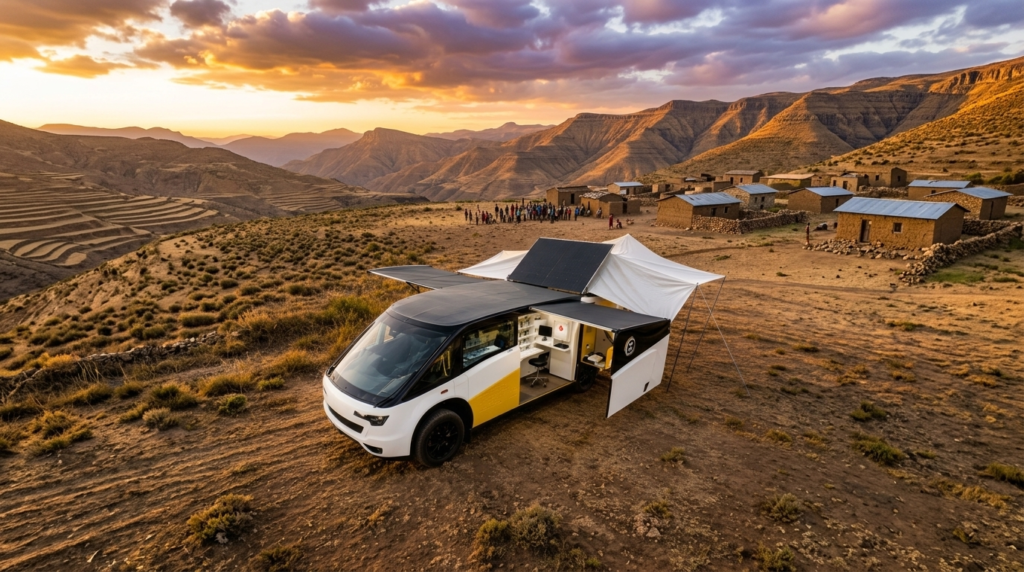
The engineering is what makes the solar-powered ambulance notable. Stella Juva carries rooftop solar panels that charge the vehicle while it drives, plus extendable panels that fold out when it is parked, effectively turning it into a stationary clinic. Onboard, it houses an X-ray machine, an ultrasound scanner, and vaccine refrigeration, equipment that normally demands a reliable grid connection. Remarkably, the team reported that the vehicle achieved a net energy surplus when stationary with all equipment running simultaneously, meaning it can generate more power than it consumes even while operating as a full diagnostic unit. The project rides a wider electrification push, also behind Range Rover’s first fully electric model.
At a glance, the mobile clinic combines vehicle-integrated solar with hospital-grade diagnostic equipment:
- Rooftop solar panels — charge the vehicle’s battery while driving.
- Fold-out extendable panels — deploy when parked to power a stationary off-grid clinic.
- Onboard diagnostics — X-ray machine, ultrasound scanner and vaccine (cold-chain) refrigeration.
- Net energy surplus — generates more power than it consumes while stationary with all equipment running.
The 800km Kenya Field Test with Amref Health Africa
The Kenya field test, conducted in August 2026 in partnership with the NGO Amref Health Africa, demonstrated the concept beyond the lab. Stella Juva traveled more than 800 kilometers (roughly 500 miles), including several hours navigating a dusty, pothole-marked clay road, to reach the Mosiro health clinic in the Narok region of southwest Kenya, a facility with no electricity of its own. Over two days, the vehicle could have treated approximately 200 people, offering a glimpse of how off-grid healthcare technology might reach communities beyond the reach of conventional infrastructure.
The results impressed even the team behind it. "We were all very positively surprised," said Isabella Wanningen, a 22-year-old computer science and engineering student on the project, adding that "Stella Juva reacted even better than we had expected." John Kutna, a program manager at Amref, was equally direct about its practical value: "The solar ambulance would be quite useful in these locations."
Solving the Off-Grid Healthcare Problem in Sub-Saharan Africa
The problem Stella Juva targets is substantial. Across much of rural sub-Saharan Africa, health facilities operate without reliable electricity, forcing clinics to run diagnostic equipment on diesel generators, which are expensive, polluting, and dependent on fuel supply chains that often break down. A vehicle that generates its own power on-site sidesteps that constraint entirely, and the Mosiro clinic test, at a facility with no grid connection of its own, was chosen specifically to prove the point in the hardest conditions. Cross-border demand for cooling and climate hardware is booming too, as when China ships 20,000 Midea AC units to France.
Commercial Potential in Clean Tech, Healthcare and Mobility
For B2B audiences in clean technology, healthcare infrastructure, and mobility, the project carries implications beyond its humanitarian appeal. Solar Team Eindhoven has developed solar vehicles since 2013, including the Stella Vita solar campervan and the Stella Terra off-road SUV, and its alumni went on to found Lightyear, a solar-EV company that has partnered with Nissan on solar-charging technology. Additionally, that track record suggests the underlying engineering has commercial potential well beyond a single demonstration vehicle, off-grid solar power paired with mobile diagnostics could apply to disaster relief, remote industrial sites, and rural service delivery. Chinese industrial technology is also spreading through Western supply chains, including how China is quietly automating British shopping.
Why the Student–NGO Partnership Model Matters
The partnership model is also instructive. By pairing student engineers with an established health NGO in Amref Health Africa, the project grounded its design in the actual needs of the communities it aims to serve, rather than building technology in isolation and hoping it fits. That collaboration between academic engineering and on-the-ground health expertise is a template other clean-tech ventures targeting emerging markets could learn from, since the hardest part of deploying such solutions is rarely the technology itself but its fit with local conditions and workflows.
From Proof of Concept to Deployable Fleet
In the end, Stella Juva is a proof of concept rather than a mass-produced product, and scaling it into a deployable fleet would require manufacturing partners, funding, and regulatory approval across markets. But by proving that a solar-powered ambulance can operate as a self-sufficient mobile clinic in genuinely difficult conditions, the Dutch team has shown that clean-energy design can solve infrastructure problems, not just reduce emissions, a message that resonates across sectors betting on solar EV innovation. Demand for solar hardware is climbing, with buyers sourcing panels from energy product suppliers.
Frequently Asked Questions (FAQs)
It is Stella Juva, a solar-powered ambulance and off-grid mobile clinic built by Solar Team Eindhoven, a group of 23 Dutch student engineers from Eindhoven University of Technology and two other institutions. It is designed to bring diagnostic healthcare to communities in Africa that lack a reliable electricity grid.
Stella Juva uses rooftop solar panels that charge the vehicle while it drives, plus extendable panels that fold out when it is parked to power a stationary clinic. The team reported it achieved a net energy surplus when stationary, generating more power than it consumes even with all onboard equipment running.
The mobile clinic houses an X-ray machine, an ultrasound scanner, and vaccine refrigeration — diagnostic and cold-chain equipment that normally requires a reliable grid connection. Running it on solar power lets clinics operate without diesel generators.
It completed an 800-kilometre (roughly 500-mile) field test in Kenya in August 2026, in partnership with the NGO Amref Health Africa. The route ended at the Mosiro health clinic in the Narok region of southwest Kenya, a facility with no electricity of its own, and over two days the vehicle could have treated about 200 people.
Solar Team Eindhoven has developed solar vehicles since 2013, including the Stella Vita solar campervan and the Stella Terra off-road SUV. Its alumni went on to found Lightyear, a solar-EV company that has partnered with Nissan on solar-charging technology.
Across much of rural sub-Saharan Africa, health facilities operate without reliable electricity and must run diagnostic equipment on diesel generators that are expensive, polluting, and dependent on fragile fuel supply chains. A solar-powered ambulance generates its own power on-site, sidestepping that constraint entirely.
Not yet. Stella Juva is a proof of concept rather than a mass-produced product. Scaling it into a deployable fleet would require manufacturing partners, funding, and regulatory approval across markets, though the underlying off-grid solar and mobile-diagnostics engineering could also apply to disaster relief and remote industrial sites.