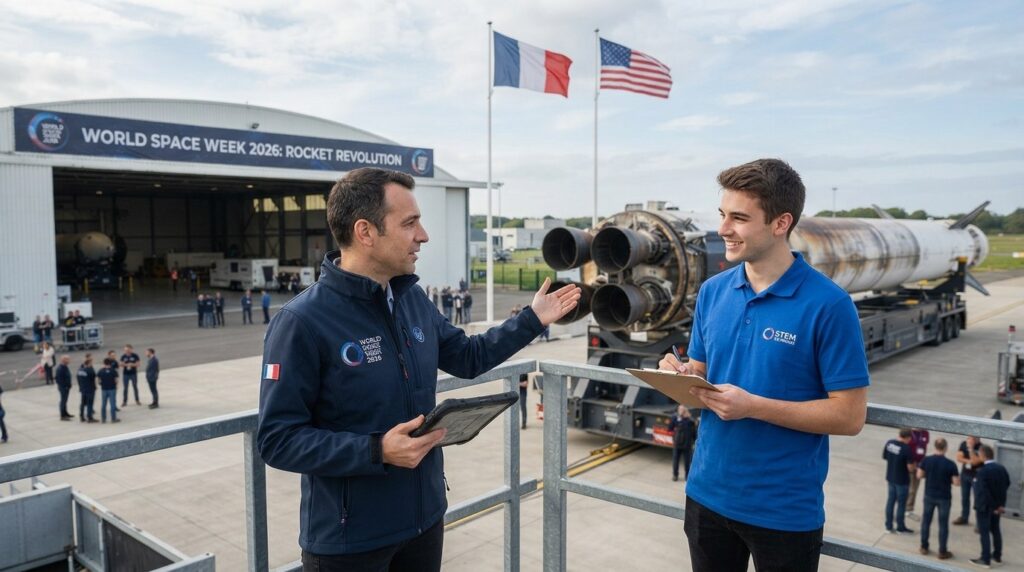
- World Space Week 2026 runs October 4 to 10 under the theme "Rocket Revolution," spotlighting launch technology and reusable rockets.
- It is the largest annual space event on Earth, with events across more than 90 countries.
- Falling launch costs are widening access to orbit, creating openings for startups, agencies and the wider space supply chain.
- United Nations — declared World Space Week in 1999
- The Planetary Society — tracks the launch trends behind the theme
- Sputnik 1 and the Outer Space Treaty — the two milestones the October 4 to 10 dates honor
World Space Week 2026 is here. The global event runs from October 4 to 10. This year’s theme is “Rocket Revolution.” It spotlights advances in launch technology. It also celebrates reusable rockets. World Space Week 2026 is the largest space event on Earth. The United Nations declared the observance decades ago. Thousands of events take place across more than 90 countries. For the space sector, it is a key week.
The theme fits the moment well. Launch costs are falling fast. Reusable rockets now fly often. As a result, access to orbit is widening. World Space Week 2026 puts that progress on display.
The Essentials of the Week
- World Space Week 2026 runs from October 4 to 10.
- The theme is “Rocket Revolution.”
- It is the largest annual space event on Earth.
- Events span more than 90 countries.
- The focus is launch tech and reusable rockets.
What World Space Week 2026 is and when it runs
World Space Week is a yearly global observance. The United Nations declared it in 1999. It always runs on the same dates. Those dates are October 4 to 10. They mark two historic milestones. Sputnik 1 launched on October 4, 1957. The Outer Space Treaty took effect on October 10, 1967. So the window honors both events. The week has grown every year since. It now spans schools, firms, and agencies. World Space Week 2026 keeps that tradition alive. Space.com explains the 2026 theme in detail.
Inside the ‘Rocket Revolution’ theme
The 2026 theme has a clear message. Rockets are changing the space economy. In past years, launches were rare and costly. Now reusable rockets fly again and again. That shift lowers the price of reaching orbit. The two ideas below explain why it matters.
Reusable rockets and falling launch costs
Reusable rockets land and fly again. Each reflight saves money. Lower costs open space to new players. Startups can now afford launches. Governments can fund more missions. In other words, reuse drives a real revolution. Turnaround times also keep shrinking. Rockets return to flight within weeks. That speed boosts total launch capacity.
What it signals for the launch market
A cheaper launch market grows quickly. More satellites can reach orbit. New services then become possible. Earth observation and broadband both expand. The Planetary Society tracks these launch trends closely. The commercial launch race is clearly heating up. New rockets reach the pad each year. Rideshare missions pack many satellites at once. Costs keep sliding as volume grows. So the market widens for everyone.
Why World Space Week 2026 matters for the space economy
World Space Week 2026 is more than outreach. It shapes talent and investment. Students meet the space industry up close. Companies show new technology to the world. Agencies connect across borders. The benefits are broad:
- Public awareness feeds the STEM talent pipeline.
- It showcases launch advances to industry buyers.
- It links more than 90 national markets and agencies.
Additionally, the week builds momentum for funding. Investors follow the attention it creates. Media coverage lifts public interest too. New partnerships often form during the week. Universities showcase research and prototypes. Small firms meet larger primes face to face. In this way, the week seeds future deals.
Why a ‘Rocket Revolution’ theme now
The timing is not random. Reusable rockets reached a tipping point. Launch cadence hit new records. Costs per kilogram kept dropping. So organizers chose a fitting theme. Ultimately, “Rocket Revolution” captures the current mood. It frames a decade of rapid change.
Opportunities for the space supply chain
The space boom needs a wide supply base. Rockets and satellites use many parts. Sensors, alloys, and electronics all matter. Launch providers source from global vendors. In addition, ground systems need steady suppliers. Companies seeking space-grade components can search a digital B2B platform for verified partners. That helps smaller firms join the supply chain. It also widens sourcing beyond local vendors. Reliable suppliers reduce delays and cost risk. Growth is clearly visible across the sector. Omnidea bought Orbex’s assets to build a UK space-engineering base. Deals like this expand launch capacity.
How businesses can take part
Participation is open and simple. Companies can host open days and talks. They can run product demos for clients. They can also support STEM outreach. Many firms register events with the organizers. In short, the week rewards visible engagement. Schools run workshops and star-gazing nights. Museums host launch screenings for families. Firms publish research and host webinars. Each activity builds the talent pipeline. Fresh ideas often come from young engineers. Student teams recently built a solar-powered mobile clinic, showing that spirit.
A busier sky and new services
More launches change daily life. Satellites now power many services. They guide maps and track weather. They also connect remote regions. Broadband from space keeps expanding. Each new launch adds network capacity. The “Rocket Revolution” makes this possible. So the theme reaches beyond rockets. It touches communication and logistics. For business, the ripple effects are large. Logistics firms track these gains closely. Better satellite data improves global shipping. Precision timing supports finance and power grids. In other words, space now shapes trade.
What will the ‘Rocket Revolution’ mean by 2027?
The trend points in one direction. Launch costs should keep falling. More players should reach orbit. New space services should appear. World Space Week 2026 marks the halfway point of a shift. By 2027, the “Rocket Revolution” may look even bigger. For now, the sector has clear momentum. The theme also inspires new talent. Students today may launch tomorrow. That human pipeline matters most.
Frequently Asked Questions (FAQs)
It is a United Nations observance. It runs every year from October 4 to 10. It is the largest space event on Earth.
The 2026 theme is “Rocket Revolution.” It highlights launch and reusable-rocket advances.
They mark two milestones. Sputnik 1 launched on October 4, 1957. The Outer Space Treaty took effect on October 10, 1967.
Events happen in more than 90 countries. Thousands of activities run each year.
Firms can host talks, demos, and open days. They can also register events with the organizers.