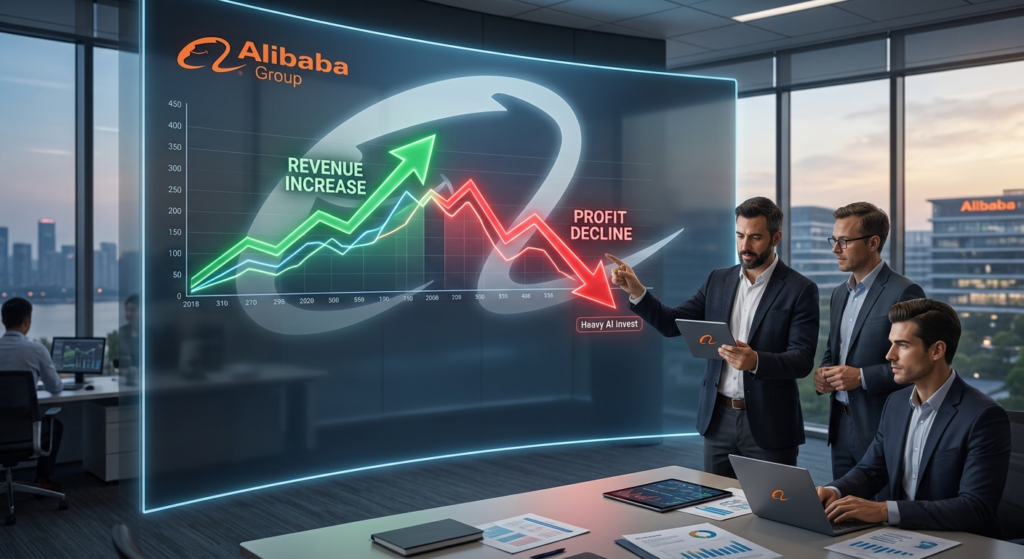
- Alibaba's revenue rose 9% to RMB268.95 billion, but net income fell nearly 75% as AI-infrastructure capex jumped 75% to RMB67.68 billion.
- The profit drop reflects heavy investment rather than a slowdown — AI cloud revenue grew 45% and AI-product revenue posted triple-digit growth.
- The company signaled it will exceed its original RMB380 billion three-year capex target, saying no compute capacity sits idle.
- Alibaba — revenue up, profit squeezed by AI capex
- Tencent — rival with an even sharper capex acceleration
- Lenovo — hardware maker benefiting from the same AI demand
Alibaba Group’s quarterly revenue jumped 9% year over year to RMB268.95 billion, but its net income dropped nearly 75% to RMB10.54 billion, which was the number moving markets. The Alibaba AI spending profit decline is not an indicator of a business slowdown, as the company attributed its primarily to increased investments in AI infrastructure through capital expenditure (capex), which rose 75% to RMB67.68 billion.
The quarter’s headline numbers make the trade-off clear:
| Metric | Result | Change |
|---|---|---|
| Group revenue | RMB268.95 billion | +9% YoY |
| Net income | RMB10.54 billion | −75% YoY |
| AI-infrastructure capex | RMB67.68 billion (~$9.4 billion) | +75% |
| AI cloud & computing revenue | RMB48.44 billion | +45% YoY |
| AI-product revenue | RMB12.38 billion | Triple-digit, 12th straight quarter |
Alibaba’s AI Cloud Revenue Is Growing Fastest
Stability in revenue growth was echoed in all reporting, with Bloomberg, CNBC, TechNode, and Caixin Global publishing their coverage within a single day of release: profit growth picked up the slack as the cost of a ‘rushing’ AI investment. Meanwhile, Alibaba’s AI cloud and computing revenue increased by 45% year-over-year to RMB48.44 billion, while its revenue generated from AI-related products jumped by more than triple digits for the 12th consecutive quarter, at RMB12.38 billion. Put another way, the parts of Alibaba’s AI infrastructure capex that are growing fastest are the same parts that are gaining momentum. The investment isn’t just about the balance sheet; it’s about getting measurable traction. Its ballooning capex tracks the AI data center boom behind the global memory chip shortage.
What RMB67.68 Billion in Quarterly Capex Signals
Alibaba’s AI capex rise is a significant amount that B2B (business-to-business) tech buyers and investors need to sit with. The amount of RMB67.68 billion in a single quarter is equivalent to $9.4 billion at current exchange rates, which is what Bloomberg rounded to in its own headline, $10 billion, and puts Alibaba firmly in a race for AI investments taking place across the broader Chinese space alongside the likes of Baidu, Tencent and ByteDance, who’ve all announced increased investment in AI over the last year. Enterprises comparing AI-era suppliers and tools increasingly turn to the IndustryTC B2B product marketplace.
AI Becomes Its Own Operating Group
Furthermore, Alibaba reorganized its e-commerce, cloud-computing, and AI-model units into separate operating groups as part of the restructuring, indicating that AI is not just another business initiative thrown under the radar of the existing cloud business; it’s a strategic priority in its own right, with its own reporting line.
How Markets Reacted to the Profit Squeeze
The market’s reaction was mixed. Alibaba shares fell roughly 5% following the earnings release, according to CNBC, as investors weighed near-term profit erosion against long-term AI positioning. That reaction is familiar in the current cycle: cloud providers globally have faced similar scrutiny as AI infrastructure spending outpaces near-term returns. Monetization is the other side of the AI-cost equation, seen in OpenAI’s new ChatGPT ad market.
B2BInside recently covered Lenovo’s Q1 revenue jump of 43% to a record $26.9 billion, driven by the same AI demand surge now pressuring Alibaba’s margins; the two stories are effectively two sides of the same trend, with AI infrastructure spending expanding across the supply chain, benefiting hardware makers even as it compresses margins for the cloud operators funding the buildout. Rivals are riding the same wave, with Lenovo’s revenue jumping 43% on AI demand.
Rivals Are Spending Even Faster
Alibaba is not spending in isolation. Rival Tencent posted an even sharper acceleration, with first-quarter capex reaching RMB31.9 billion, a 63% jump from the prior quarter, and Goldman Sachs projects Tencent’s annual capex will more than double by 2027 to RMB165 billion.
Alibaba Set to Exceed Its RMB380 Billion Capex Target
Alibaba, for its part, has effectively acknowledged it will exceed its own original three-year capex target of RMB380 billion, roughly $56 billion, for AI data center buildout, a target set before demand accelerated as sharply as it has this year. As a cloud hyperscaler, Alibaba’s leadership framed the urgency bluntly: the company said “there isn’t a single card on our service that is idle,” pointing to compute capacity constraints, not excess spending, as the real driver behind the capex increase.
Will Alibaba’s AI Investment Pay Off?
Ultimately, whether Alibaba’s AI infrastructure capex pays off depends on how quickly its 45% AI cloud revenue growth can scale relative to the cost of the underlying compute. A 75% capex increase is not sustainable indefinitely without a corresponding acceleration in monetization, and Alibaba’s own results suggest awareness of this: AI product revenue has posted triple-digit growth for three consecutive years of quarters, a pace few competitors have matched. Chinese tech giants face investor scrutiny across the board, including Shein’s Hong Kong debut.
Additionally, Alibaba’s results land amid a broader reassessment of AI capital spending across the technology sector, where investors are increasingly distinguishing between infrastructure investment that produces visible revenue growth, as Alibaba’s cloud and AI product segments currently show, and speculative spending without a clear monetization path. Alibaba’s AI cloud revenue growth gives it a stronger case than some peers currently facing the same investor scrutiny.
The company’s next earnings report will be the clearer test. If AI cloud revenue growth continues outpacing capex growth, the current profit drop will likely be read as a temporary, planned dip. If the gap widens instead, expect scrutiny on Alibaba’s AI spending to intensify. Cheaper models may ease the pressure, as Anthropic’s Opus 5 nears flagship performance at half the price.
Frequently Asked Questions (FAQs)
Alibaba’s revenue rose 9% year over year to RMB268.95 billion, but net income dropped nearly 75% to RMB10.54 billion. The decline reflects heavy AI investment rather than a business slowdown: capital expenditure on AI infrastructure rose 75% to RMB67.68 billion in a single quarter.
Alibaba’s AI-infrastructure capex reached RMB67.68 billion in the quarter, up 75% year over year. That is equivalent to about $9.4 billion at current exchange rates, which Bloomberg rounded to $10 billion in its headline, placing Alibaba in the front rank of Chinese AI spenders alongside Baidu, Tencent, and ByteDance.
Yes. Alibaba’s AI cloud and computing revenue grew 45% year over year to RMB48.44 billion, and revenue from AI-related products posted triple-digit growth for the 12th consecutive quarter, reaching RMB12.38 billion. The fastest-growing parts of the capex are also the fastest-growing sources of revenue.
Alibaba shares fell roughly 5% following the earnings release, according to CNBC, as investors weighed near-term profit erosion against long-term AI positioning. The reaction mirrors scrutiny cloud providers globally have faced as AI infrastructure spending outpaces near-term returns.
Alibaba’s original three-year capex target was RMB380 billion, roughly $56 billion, for AI data center buildout. The company has effectively acknowledged it will exceed that figure, saying “there isn’t a single card on our service that is idle” and pointing to compute-capacity constraints rather than excess spending.
Tencent posted an even sharper acceleration, with first-quarter capex reaching RMB31.9 billion, a 63% jump from the prior quarter. Goldman Sachs projects Tencent’s annual capex will more than double by 2027 to RMB165 billion, underscoring how broad the Chinese AI-investment race has become.
It depends on whether 45% AI cloud revenue growth can keep scaling relative to the cost of the underlying compute. A 75% capex increase is not sustainable indefinitely without faster monetization, so the next earnings report will be the clearer test of whether the profit drop is a planned, temporary dip.